

Key Takeaways
- Both home and gym workouts can produce meaningful fitness results when done consistently.
- The gym offers greater equipment variety and social energy; home offers unmatched convenience and zero commute.
- Motivation, accountability, and progression strategies differ significantly between the two environments.
- Many people find a hybrid approach — some sessions at home, some at the gym — works best long-term.
- The environment that supports your consistency is ultimately the one that wins.
Our Verdict
Neither home workouts nor gym sessions are universally superior — the right choice depends on your lifestyle, goals, and what keeps you showing up. Equipment matters far less than environment, habit, and how well you manage progression over time.
| Best for | Recommended |
|---|---|
| Those with busy schedules or limited commute time | Home workouts |
| People who thrive on social energy and need access to varied resistance equipment | The gym |
| Anyone pursuing serious strength or muscle-building goals | The gym |
| Those who want maximum flexibility and low barriers to starting | Home workouts |
The Real Differences Start Before You Even Exercise
The gym-vs-home debate usually gets framed around cost or equipment access. But the more meaningful differences show up in motivation, psychology, and the friction between you and actually getting started.
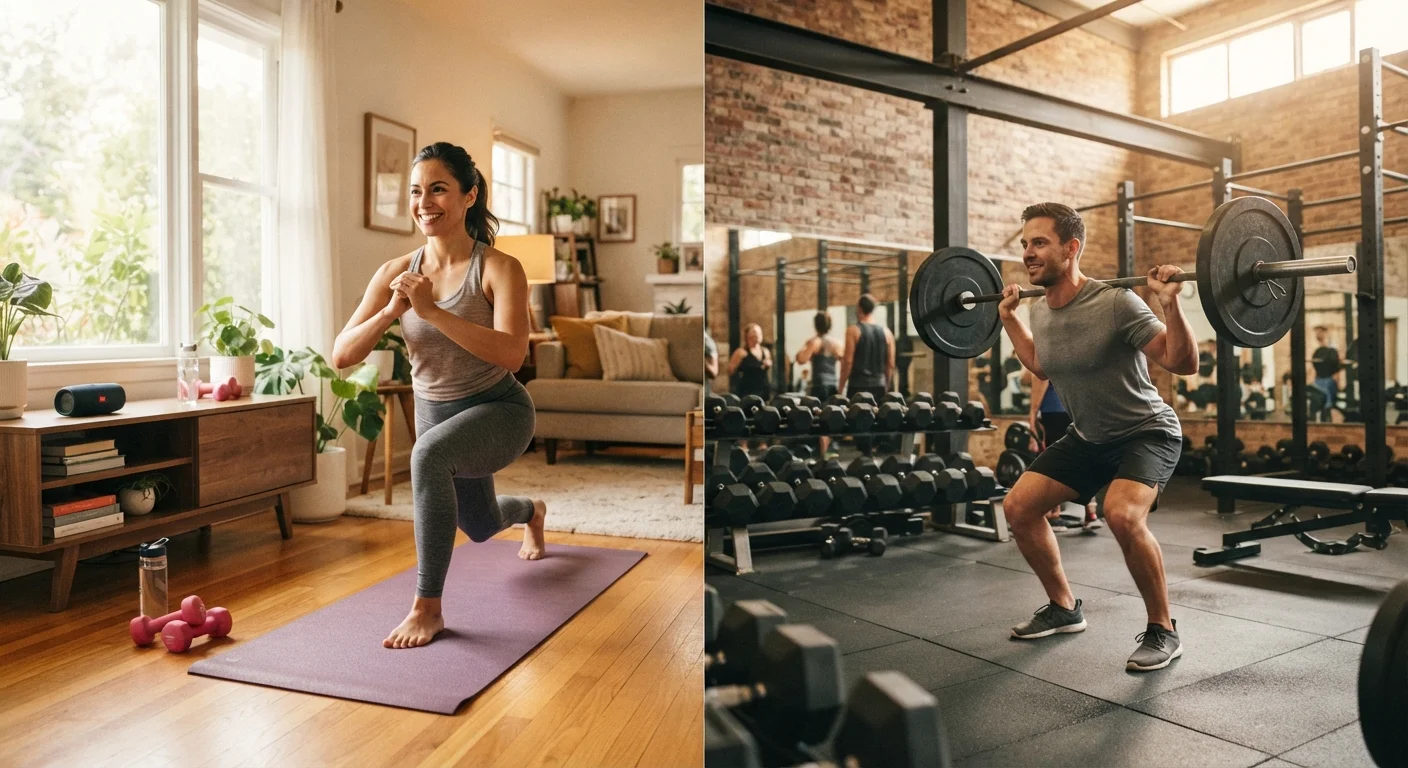
Going to a gym involves a commute, changing clothes, and navigating a shared space. For some people, that ritual is energizing — it signals that exercise time has begun. For others, it's exactly the kind of friction that turns a planned workout into a skipped one. Home removes almost all that friction. Your mat is ten steps away. There's no audience. No wait for equipment. But without a clear boundary between "home" and "workout space," it's also easier to get distracted or cut sessions short.
Neither psychology is better or worse — but understanding your own tendencies is crucial. If you skip gyms because getting there feels like too much, that's data worth acting on. If you routinely get distracted at home, that's equally important to know. The structure of your weekly routine often matters more than where the workout happens.
Motivation and Accountability: Two Very Different Ecosystems
Gyms provide built-in social accountability. Seeing others exercise, working with a trainer, or simply not wanting to leave a paid membership unused all create external motivators. Research in behavioral science consistently shows that environmental cues and social context influence follow-through — the gym environment is engineered, intentionally or not, to keep you moving.
Home workouts require more self-generated motivation. The upside is that self-motivated exercisers often develop stronger intrinsic habits — they exercise because they want to, not because they're paying for the space. The downside is that this takes time to build. If you're new to exercise or returning after a break, external accountability tends to help significantly in the early weeks.
Try a Hybrid Approach First
If you're unsure which environment suits you, start by experimenting with both. Designate two or three home sessions per week and one gym visit. After a month, notice which sessions you're more likely to skip — that's often the clearest signal about which environment supports your consistency. You don't have to commit to one or the other permanently.
It's also worth noting that online classes, virtual personal training, and fitness apps have partially bridged this gap, bringing structure and community to home exercise without the commute.
Progression: Where the Gym Has a Real Edge
One area where the gym genuinely outperforms home setups for many people is progressive overload. This is the principle of gradually increasing the demand placed on your body — adding weight, reps, or complexity over time — which is what drives long-term improvement in strength, endurance, and muscle development.
At a gym, incrementally heavier weights are always available. Barbells, cable machines, and resistance equipment make it straightforward to add small, measurable load increases. At home, progression requires more creativity: adding reps, slowing tempo, switching to harder movement variations (like progressing from a knee push-up to a full push-up to an archer push-up), or investing in adjustable dumbbells or resistance bands.
| Home Workouts | The Gym | |
|---|---|---|
| Convenience | No commute, always accessible | Requires travel time and scheduling |
| Equipment variety | Limited unless you invest | Extensive, ready to use |
| Progressive overload | Requires creativity and planning | Structurally easier with available weights |
| Motivation style | Self-directed, intrinsic | Social, environmental cues |
| Cost over time | Low after initial setup | Ongoing membership fees |
| Flexibility of timing | Anytime, any duration | Dependent on gym hours |
| Intimidation factor | None — private space | Can feel daunting for beginners |
Neither path is a dead end, but gym-goers often find it structurally easier to keep adding challenge without thinking too hard about it. Home exercisers need to be more intentional — which is entirely doable with the right mindset and some planning.
Variety, Recovery, and What Each Environment Supports
Gyms typically offer cardio machines, free weights, resistance machines, group classes, pools, and stretching areas — a broad ecosystem that supports varied training across strength and cardio goals. That variety is genuinely useful for avoiding plateaus and keeping exercise interesting, especially once you've been training for months or years.
Home workouts tend to excel in flexibility and recovery-friendly movement. Yoga, mobility work, bodyweight circuits, and low-intensity cardio are all highly accessible at home and require minimal space. For people managing busy weeks, short home sessions can maintain consistency even when a full gym session isn't realistic.
One underrated factor: home allows you to work out on your own schedule, including at unconventional times, without social self-consciousness. For people who feel intimidated by gym environments — a very common and valid experience — home exercise removes a genuine barrier to starting. It's worth separating that discomfort from fitness myths about what a "real" workout looks like.
This article is for general informational purposes only and does not constitute medical or personal fitness advice. Consult a qualified healthcare or fitness professional before beginning a new exercise programme, especially if you have any health conditions or concerns.