

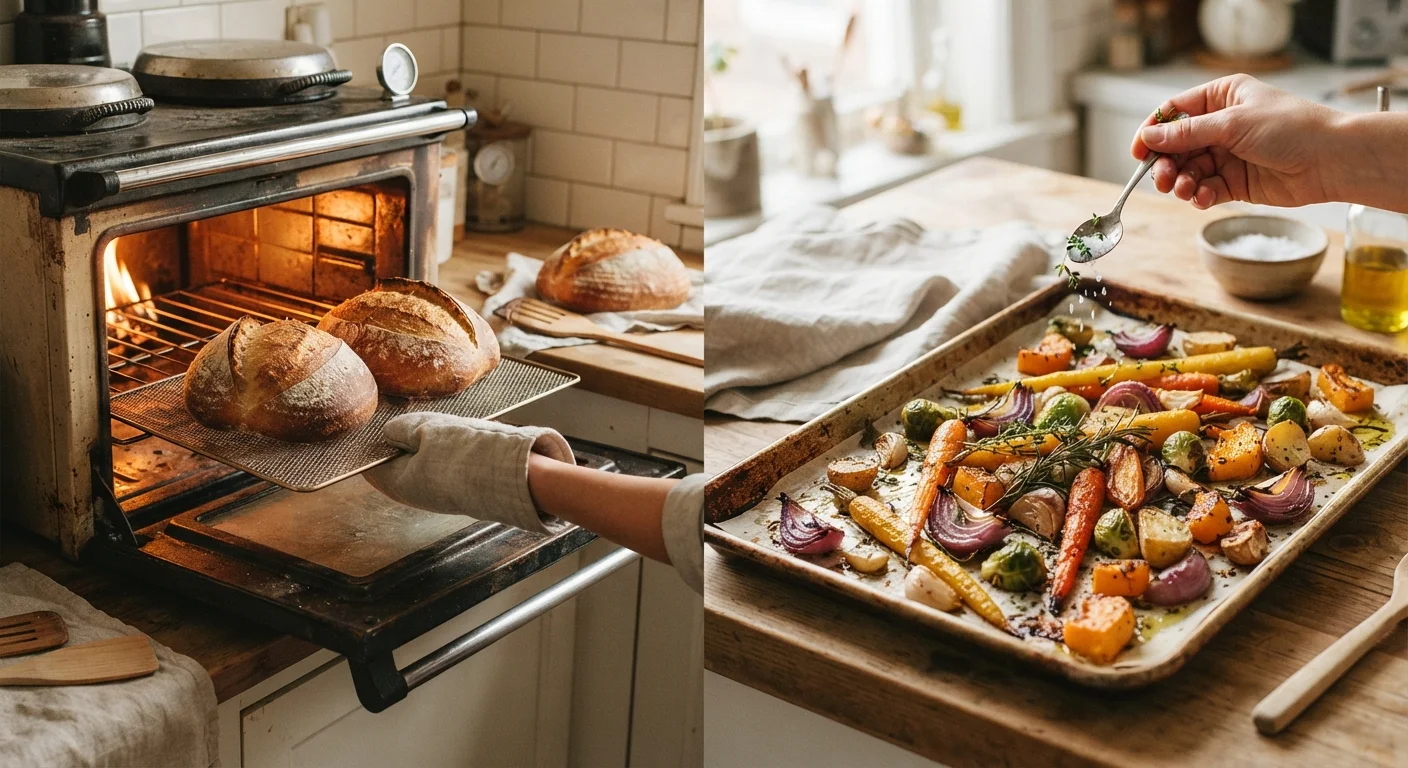
Key Takeaways
- Baking and roasting both use dry oven heat, but they serve different culinary purposes.
- Baking relies on chemical structure changes; roasting focuses on surface browning and caramelization.
- Temperature ranges overlap, but roasting typically runs hotter than most baking.
- Food type — structured vs. naturally firm — is the clearest guide for choosing the right method.
- Understanding both techniques helps you get predictably better results from your oven.
Our Verdict
Baking and roasting are closely related dry-heat methods, but they work toward different goals. Baking builds structure in liquid or soft mixtures; roasting unlocks flavor through browning in already-solid foods. Knowing which method fits your ingredient helps you use your oven with genuine intention rather than guesswork.
| Best for | Recommended |
|---|---|
| Breads, cakes, muffins, and casseroles | Baking |
| Vegetables, whole cuts of meat, and potatoes | Roasting |
| Foods that need a firm crust outside and soft interior | Roasting |
| Foods that start liquid or semi-liquid and need to set | Baking |
What They Actually Have in Common
Both baking and roasting use the same tool — a closed oven — and both rely on dry, ambient heat to cook food. Neither requires added water, steam, or submerging food in liquid. That shared foundation is why the two terms get used interchangeably in casual conversation. But the similarities mostly stop there. Purpose, food type, and the transformation you're aiming for are what actually separate one technique from the other.
If you've ever wondered why a recipe says "roast the carrots" but "bake the casserole," you're already asking the right question. The answer is rooted in how each method treats food differently at a structural and flavor level.
The Core Distinction: Structure vs. Browning
Baking is typically applied to foods that begin in a liquid or semi-liquid state and need heat to set their structure. Think bread dough, cake batter, muffin mix, or custard. The heat triggers chemical reactions — gluten development, protein coagulation, leavening gases expanding — that transform a pourable mixture into something sliceable and firm. Precision matters enormously here; a slight temperature swing can affect rise, texture, and crumb.
Roasting, by contrast, is applied to foods that are already structurally solid — whole vegetables, chunks of potato, bone-in chicken, or a beef tenderloin. The goal isn't to build structure but to develop surface flavor through browning, caramelization, and the Maillard reaction (the chemical process that creates that irresistible savory crust). You want the outside to transform while the inside stays moist and tender.
| Baking | Roasting | |
|---|---|---|
| Typical food state | Liquid or semi-liquid (batters, doughs) | Solid (vegetables, meats, whole cuts) |
| Primary goal | Build structure and set shape | Develop surface browning and flavor |
| Typical temperature range | 325°F – 375°F | 375°F – 450°F |
| Common pan types | Loaf pans, cake pans, muffin tins | Sheet pans, open roasting pans |
| Key chemical process | Gluten set, leavening, protein coagulation | Maillard reaction, caramelization |
| Precision required | High — small changes affect outcome | More forgiving — timing is flexible |
For more techniques that hinge on heat management, see our guide to sautéing vs. pan-frying — a useful comparison for stovetop decisions.
Temperature and Pan Setup
Temperature ranges do overlap — both methods can operate anywhere from 300°F to 450°F — but roasting generally runs hotter. Most roasting happens between 375°F and 450°F, where high heat drives surface evaporation quickly and promotes browning. Baking tends to hover in the 325°F–375°F range to allow gentler, more even heat penetration that won't collapse a delicate structure before it sets.
Give Roasted Foods Room to Breathe
Crowding vegetables or meat on a roasting pan traps steam and causes the food to braise rather than roast, which means no browning. Spread food in a single layer with space between pieces. If your pan is full, use two pans instead of piling food high.
Pan choice also reflects the difference. Baking often uses enclosed or high-sided pans — loaf pans, round cake pans, muffin tins — that hold batter in place and moderate heat distribution. Roasting calls for rimmed sheet pans or open roasting pans that let hot air circulate freely around the food, encouraging even browning on all exposed surfaces.
When the Lines Blur
Some foods genuinely sit at the boundary. A baked potato starts firm (suggesting roasting) but is often called "baked." A whole roasted chicken might share oven space with a dish of mac and cheese that's technically being baked. Recipes themselves don't always agree on terminology, and regional conventions vary.
A practical rule: if you're trying to set something that starts wet, bake it. If you're trying to brown and deepen flavor in something already solid, roast it. When in doubt, follow the recipe's temperature and pan instructions — those details tell you more than the label does. Building this instinct is one of the genuinely useful fundamentals that makes every oven-based recipe feel less mysterious.
325°F–450°F
Shared dry-heat oven range
Both baking and roasting operate within this range, though each method favors different ends of the spectrum.
~154°C
Temperature where Maillard browning begins
The Maillard reaction — responsible for roasted crust and flavor — typically activates around 310°F (154°C) on food surfaces.