

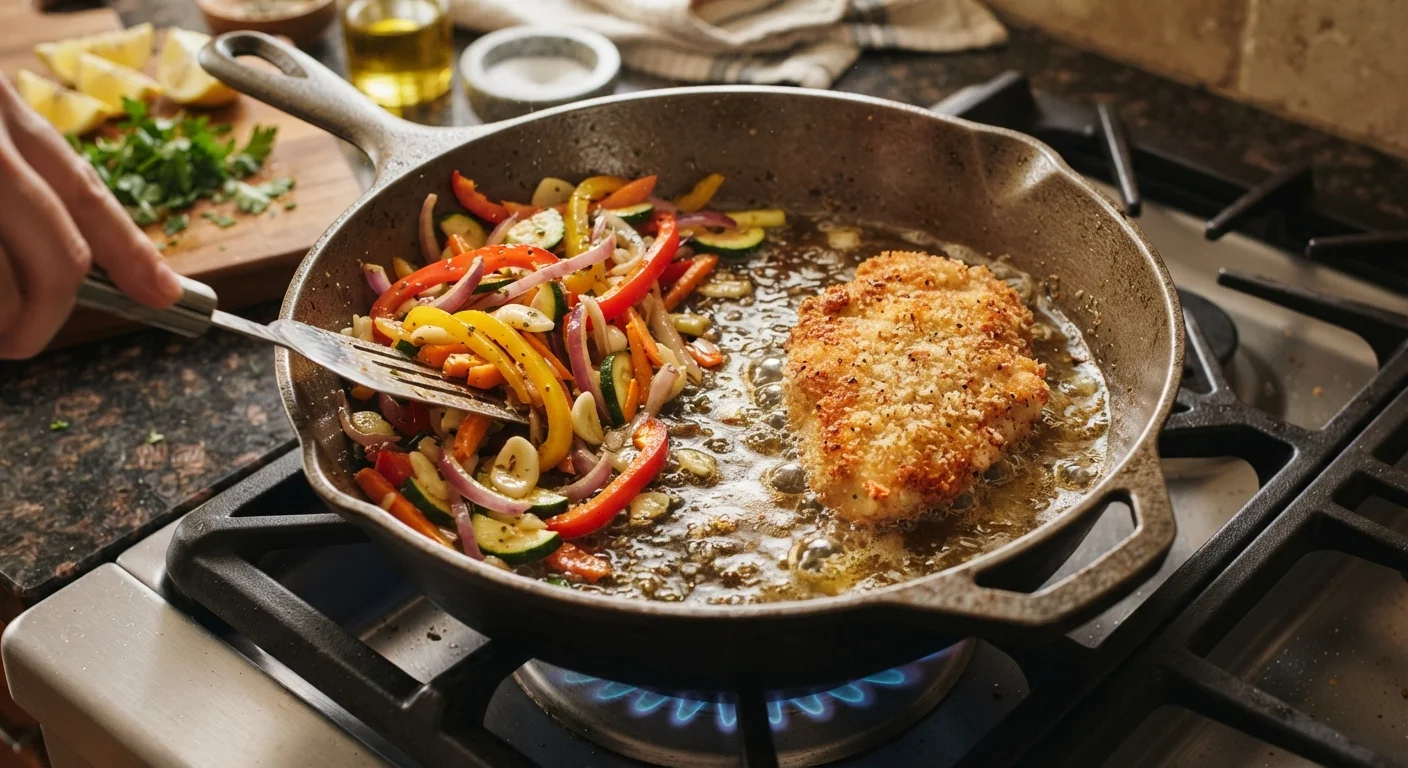
Key Takeaways
- Sautéing uses very little fat and very high heat to cook small pieces quickly.
- Pan-frying uses more fat and moderate heat to develop a crispy crust on thicker foods.
- The size and thickness of your ingredient should guide which method you choose.
- Keeping food moving is key when sautéing; pan-frying requires minimal disturbance.
- Both methods work best in a heavy-bottomed skillet that holds heat evenly.
Option A
Sautéing
The quick, high-heat technique for tender, lightly browned food.
Best for: Best for small, thin, or pre-cut ingredients that cook through in just a few minutes — think garlic, diced onions, shrimp, or sliced mushrooms.
Option B
Pan-Frying
The slower, fat-forward method for a crispy, cooked-through result.
Best for: Best for thicker, denser foods — like bone-in chicken thighs, pork chops, or breaded cutlets — that need time to cook through without burning the surface.
If you want a fast weeknight side dish with vegetables or shrimp
Sautéing
High heat and quick tossing gets thin, small ingredients cooked and lightly caramelized in under 10 minutes — minimal fat, maximum flavor.
If you're cooking a thick piece of protein with a crispy exterior
Pan-Frying
The extra fat and moderate heat create the time and insulation needed to brown the outside evenly while cooking the interior all the way through.
If you're a beginner building foundational stovetop confidence
Sautéing
Sautéing is forgiving on timing and requires less fat management, making it an ideal first technique to master before moving on to pan-frying.
If you want breaded or coated foods with a defined golden crust
Pan-Frying
The shallow oil bath in pan-frying surrounds the coating evenly, crisping it up in a way high-heat sautéing simply cannot replicate.
What Makes These Two Techniques Different
Both sautéing and pan-frying happen on a stovetop in a skillet — so it's easy to assume they're the same thing with a different name. They're not. The differences come down to three core variables: the amount of fat used, the heat level, and how long the food stays in the pan.
Sautéing (from the French word sauter, meaning "to jump") uses a very thin film of fat — just enough to coat the pan — at high heat. The goal is to cook food quickly while developing light color and flavor. You keep things moving, either by tossing or stirring frequently.
Pan-frying uses significantly more fat — typically enough to come about a third to halfway up the side of the food — at a moderate heat. The goal is a deeply browned, crispy exterior with a fully cooked interior. The food sits largely undisturbed so the crust can set.
If you've ever wondered why some recipes call for techniques that sound interchangeable, our guide to common cooking terms breaks down the culinary vocabulary beginners encounter most often.
| Criterion | Sautéing | Pan-Frying |
|---|---|---|
| Fat amount | Very little (thin film) | More (shallow pool, ~¼ inch) |
| Heat level | High | Moderate |
| Cooking time | Fast (3–8 minutes) | Slower (8–20 minutes) |
| Food movement | Frequent tossing or stirring | Mostly undisturbed |
| Best food types | Small, thin, or tender pieces | Thick, dense, or breaded foods |
| Resulting texture | Lightly golden, tender | Crispy crust, juicy interior |
| Ideal pan | Any skillet with a thin film of oil | Heavy cast iron or stainless steel |
How to Sauté Correctly
The most common sautéing mistake is using a pan that isn't hot enough before adding food. If the pan is lukewarm, ingredients will steam rather than sear, turning limp instead of lightly golden.
- Heat your skillet first. Place the dry pan over medium-high to high heat for 1–2 minutes before adding fat.
- Add a small amount of fat. A teaspoon or two of oil with a high smoke point — such as canola, avocado, or refined olive oil — is typically enough for a standard skillet. Not sure which fats to use? Our breakdown of fat types can help you choose wisely.
- Add your ingredients — but don't crowd the pan. Too many pieces at once drops the temperature sharply, causing steaming instead of sautéing. Work in batches if needed.
- Keep things moving. Toss or stir frequently so all surfaces get contact with the hot pan.
Sautéing works well for garlic, onions, leafy greens, sliced peppers, mushrooms, shrimp, and scallops. Most ingredients are done in 3–8 minutes.
How to Pan-Fry Correctly
Pan-frying is slower and more deliberate. The extra fat acts as a heat transfer medium, ensuring the food's surface cooks evenly even while the interior needs more time.
Watch Your Oil Temperature
If the oil isn't hot enough when food goes in, the food absorbs the fat rather than searing against it — resulting in a greasy, pale crust. A simple test: add a small drop of water or a breadcrumb to the oil. If it sizzles actively, the oil is ready. If it sits quietly, wait another 30–60 seconds before adding your food.
- Choose a heavy skillet. Cast iron or stainless steel holds heat steadily — critical for an even crust. Our guide to non-stick pans explains why non-stick surfaces aren't always the right tool for this job.
- Add enough fat. The pan should have a visible pool of oil — roughly ¼ inch deep for most applications. Heat it to the right temperature before adding food (a small breadcrumb should sizzle immediately when dropped in).
- Place food gently and leave it alone. Resist the urge to move the food. Lifting it too early tears the crust before it has set.
- Flip once. When the bottom is deeply golden and the food releases cleanly from the pan, flip it once and finish the other side.
Pan-frying suits chicken pieces, pork chops, fish fillets, and breaded cutlets. Depending on thickness, total cooking time may range from 8 to 20 minutes.
Timing your seasoning properly also affects the final result — see our primer on when to salt food for method-specific guidance.
~¼ inch
Typical oil depth for pan-frying
Most culinary references define pan-frying as using enough fat to come roughly one-third up the side of the food — distinct from deep-frying, which fully submerges it.
375°F–400°F
Typical pan-fry oil temperature range
Most culinary guides cite this range as the sweet spot for achieving a golden crust without over-browning the exterior before the interior cooks through.
Choosing the Right Method for Your Meal
The simplest decision rule: think about the size and density of what you're cooking.
- Thin, small, or tender? Sauté it.
- Thick, dense, or breaded? Pan-fry it.
Trying to pan-fry small shrimp will overcook them before any crust forms. Trying to sauté a thick pork chop will leave the center raw while the outside scorches. Matching method to ingredient is what separates frustrating results from consistent ones.
For oven-based comparisons, the same logic applies across techniques — see how baking and roasting differ if you're building out your broader cooking knowledge. Understanding a handful of core techniques makes any recipe easier to interpret — and easier to adapt when you don't have every exact ingredient on hand.