

Key Takeaways
- A budget is a proactive spending plan, not a list of things you can't buy.
- Budgets work by giving every dollar a purpose before you spend it.
- You don't need to be in debt or earn a high income to benefit from budgeting.
- A budget can — and should — include spending on things you enjoy.
- Consistent budgeting builds financial confidence over time, not just savings.
Budget
A budget is a plan that tells your money where to go before the month begins. It lists what income you expect to receive and how you intend to use it — covering bills, groceries, savings, and yes, fun. A budget doesn't forbid spending; it makes spending intentional.
In formal financial planning, a budget is a forward-looking document that allocates projected income across defined expense categories, distinct from a spending tracker, which records past transactions.
The Word 'Budget' Has a PR Problem
Ask someone how they feel about budgeting, and you'll often hear words like "restrictive," "stressful," or "not something I need right now." That reaction is understandable — the word has been associated for decades with austerity, sacrifice, and guilt over every latte. But that framing is both inaccurate and counterproductive.
A budget is simply a plan. It's a document — on paper, in a spreadsheet, or in an app — that lists the money coming in and decides, in advance, how that money gets used. That's the entire concept. Nothing in that definition says you have to give up what you enjoy. It just says you should decide intentionally, rather than finding out at the end of the month that you're short.
If the word itself bothers you, call it a "spending plan" or a "money map." The label doesn't matter. What matters is the practice: telling your money where to go before it disappears.
Start With One Month, Not a Yearly Plan
New budgeters often stall trying to plan too far ahead. Instead, focus only on the current month. List your income, write down every expense category you can think of, and assign a dollar amount to each. After 30 days, review and adjust. One realistic month beats an ambitious year-long plan abandoned in week two.
What a Budget Actually Contains
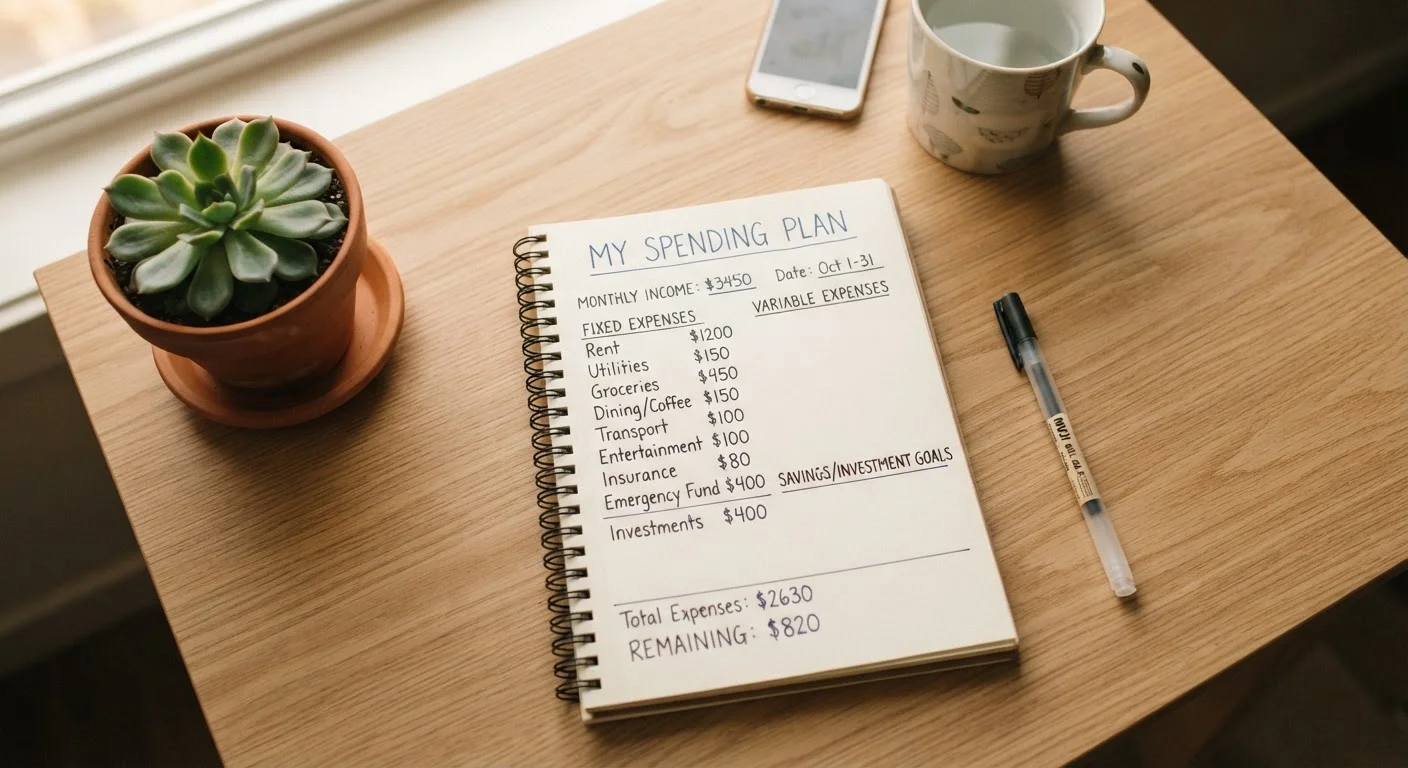
A functional budget has two sides: income and expenses. On the income side, you list every source of money coming in during the month — your paycheck, any side income, government benefits, or other regular deposits. On the expense side, you account for everything you spend money on.
Expenses typically fall into two groups:
- Fixed expenses — costs that stay the same every month, like rent, a car payment, or an insurance premium.
- Variable expenses — costs that fluctuate, like groceries, gas, dining out, or clothing.
After listing both sides, you compare them. If income exceeds expenses, you decide what to do with the difference — save it, invest it, or pay down debt. If expenses exceed income, you adjust. That adjustment might mean reducing a variable category, not eliminating everything enjoyable.
Crucially, a well-built budget includes a category for discretionary spending — the stuff that makes life pleasant. Ignoring that category doesn't make the spending disappear; it just makes your budget inaccurate. For a full breakdown of the terms used here, see this beginner's glossary of budgeting terms.
~33%
Americans who maintain a household budget
Surveys consistently find only about one-third of U.S. adults report following a formal household budget, according to Gallup polling data.
$1,000
Emergency savings threshold many households lack
Federal Reserve data has shown that a significant share of U.S. households would struggle to cover an unexpected $1,000 expense without borrowing.
Why Budgets Work — and Why They Sometimes Don't
The psychological power of a budget comes from intentionality. Research in behavioral economics consistently shows that people who plan their spending in advance make more deliberate choices than those who spend reactively. A budget creates a moment of reflection before money moves, which interrupts automatic or impulsive behavior.
Budgets fail most often for two reasons. First, people build them too rigidly — cutting every variable category to the bone, leaving no room for real life. When the first unexpected expense hits, the whole plan collapses and the person concludes budgeting "doesn't work for them." Second, people treat a budget as a one-time document instead of a living tool. A budget you wrote in January and never revisited isn't doing much by April.
Sustainable budgets are realistic, flexible, and reviewed regularly. If you're curious about the mental models that make budgeting stick long-term, habits that keep a budget running without constant willpower explores how to make the process feel less like discipline and more like routine.
“A budget is telling your money where to go instead of wondering where it went.”
— John C. Maxwell, Author and speaker on leadership and personal development
Budgeting Is a Tool, Not a Verdict on Your Life
One of the most damaging myths about budgets is that they're only necessary when something has gone wrong — that you need a budget only if you're in debt, living paycheck to paycheck, or have made financial mistakes. In reality, a budget is useful at every income level and life stage, because it answers a question everyone has: Am I using my money in a way that reflects what actually matters to me?
A person earning a comfortable income without a budget may be perfectly fine month to month — and may also be unknowingly drifting away from goals they care about. A budget makes the gap between values and behavior visible, which is the first step to closing it.
There are also common beliefs that stop people from ever starting — ideas like "I don't earn enough to budget" or "budgets are too complicated." Those beliefs don't hold up to scrutiny. See budgeting myths that keep people from starting for a direct look at the most common ones.
You don't need a perfect system. You need a starting point — and understanding what a budget actually is, rather than what you've heard about it, is exactly that.
This article is for general informational and educational purposes only. It does not constitute personalized financial advice. For guidance specific to your situation, consider consulting a qualified financial professional.