

How Language Unfolds in the Toddler Years
One of the most common worries parents bring to pediatric checkups is whether their toddler is talking enough. The reassuring truth is that language development follows a wide range — and where a child lands within that range matters far less than the direction they're heading.
Here's a general picture of how speech and language typically progress:
- 12 months: Most toddlers say 1–3 recognizable words ("mama," "dada," "uh-oh") and understand simple requests like "come here."
- 18 months: A vocabulary of roughly 10–25 words is common, with children pointing at familiar objects and following two-step instructions.
- 24 months: Many children combine two words ("more juice," "daddy go") and have a vocabulary of 50 or more words — though some typically developing children are still catching up at this point.
- 36 months: Sentences of three to four words are common; strangers can usually understand about 75% of what a child says.
These figures reflect averages drawn from large developmental studies, not fixed checkpoints every child must hit precisely on schedule. As explored in why milestone comparisons can cause unnecessary anxiety, developmental timelines are ranges, not races.
Signs Worth Mentioning to a Professional
Most speech variation is completely normal, but certain patterns are worth raising with your child's pediatrician or a speech-language pathologist — not because they signal certain delay, but because early evaluation is always more effective than a wait-and-see approach.
Consider scheduling a conversation with a professional if your toddler:
- Is not babbling or using gestures (pointing, waving) by 12 months
- Has no single words by 16 months
- Has no two-word phrases (not including imitation) by 24 months
- Loses language skills they previously had at any age — regression warrants prompt follow-up
- Is hard to understand even to family members by age 2, or to strangers by age 3
- Rarely makes eye contact or responds to their name consistently
These are prompts for a conversation, not a diagnosis. A speech-language pathologist can conduct a proper assessment and rule out underlying factors like hearing differences, which are among the most common and easily addressed contributors to language delay.
Bilingual Toddlers Develop Differently — and That's Fine
Children raised in bilingual or multilingual households may mix languages, have smaller vocabularies in each individual language, and hit some spoken milestones slightly later than monolingual peers. This is a normal part of bilingual acquisition, not a warning sign. When assessing a bilingual child, a speech-language pathologist will consider vocabulary and skills across all languages together.
For a broader look at how behavior and communication intersect during these years, see our piece on common toddler behaviour myths that trip up new parents.
How to Support Language at Home
You don't need flashcards or structured lessons to support your toddler's language growth. Research consistently shows that the quality of everyday interactions — not the quantity of formal activities — is what builds vocabulary and communication skills.
30 million
Word gap between high- and low-exposure children by age 3
Hart and Risley's foundational research highlighted that conversational exposure, not socioeconomic status alone, drives early vocabulary differences.
~1 in 12
U.S. children with speech or language disorder
According to the National Institute on Deafness and Other Communication Disorders, speech-language disorders are among the most common developmental concerns in young children.
A few evidence-informed habits make a genuine difference:
- Narrate daily life. "Now we're washing your hands — the water is warm!" This exposes children to vocabulary in context.
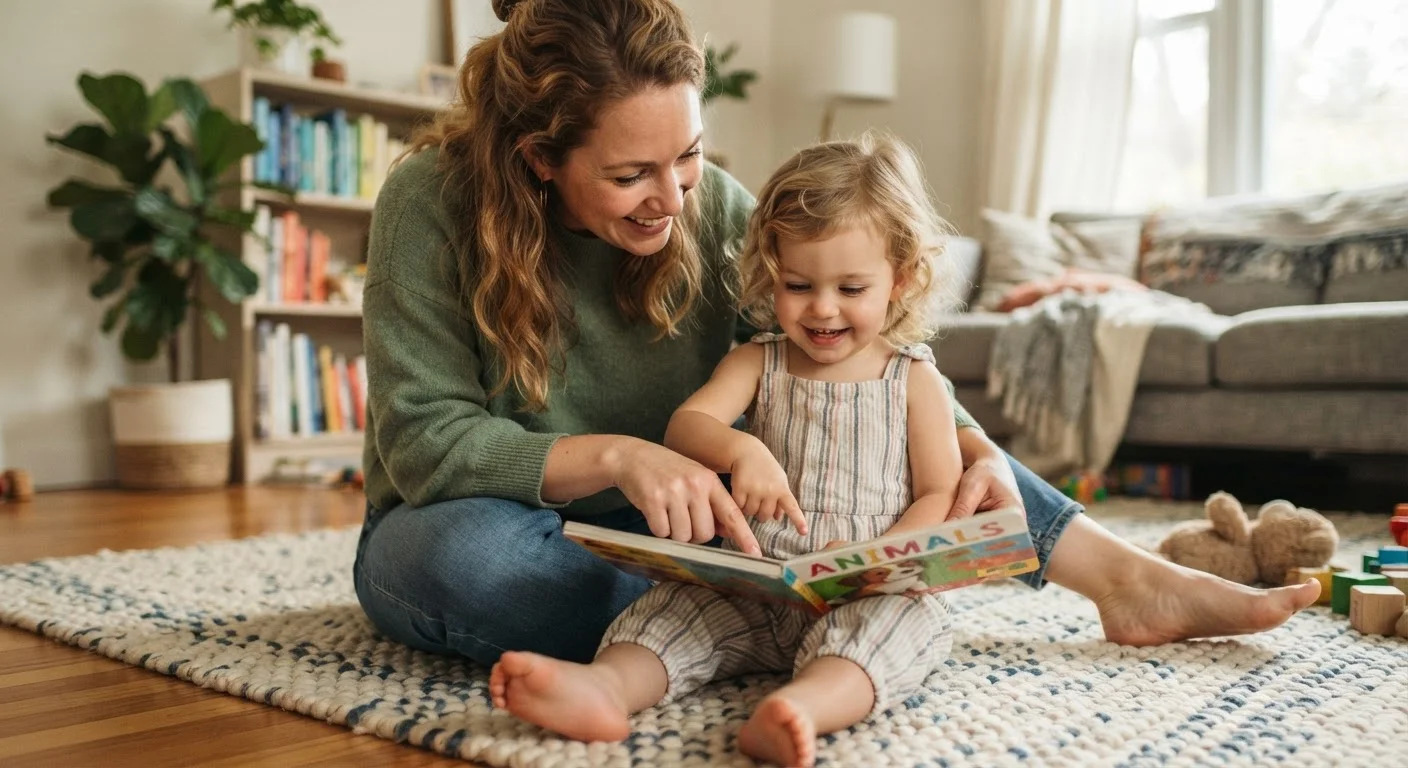
- Read aloud regularly. Shared book reading is one of the strongest predictors of early language development. Let your child point, interrupt, and ask questions — it's not about finishing the book.
- Expand what they say. If your toddler says "dog," you can say "Yes, a big brown dog!" — adding words without correcting.
- Limit background noise. Conversations compete poorly with televisions and devices running in the background. Quiet time together creates space for language.
- Follow their lead. Talk about whatever your child is focused on. Joint attention — both of you looking at or engaged with the same thing — is a powerful engine for word learning.
Language also weaves through many other areas of toddler development. Understanding what toddlers find genuinely hard — like moving from one activity to another — can make your interactions more patient and productive. Our article on why toddlers resist transitions explains the underlying reasons and how to ease them.
This article is for general informational and educational purposes only. It is not a substitute for professional evaluation or advice. If you have concerns about your child's development, please consult your pediatrician or a licensed speech-language pathologist.