

Key Takeaways
- Growth mindset means believing abilities can improve through effort — not that effort alone guarantees success.
- Praising the process (effort, strategy, persistence) is more effective than praising intelligence or talent.
- Parents and teachers can unintentionally reinforce a fixed mindset without realizing it.
- Growth mindset is most powerful when modeled at home, not just taught in school.
- Mistakes should be framed as information, not failure — this is a skill parents can practice too.
Growth Mindset
Growth mindset is the belief that intelligence and ability can be developed through effort, practice, and learning from mistakes. It contrasts with a fixed mindset, which assumes that talent and intelligence are static traits you either have or don't. Children with a growth mindset are more likely to persist when things get hard rather than giving up or avoiding challenges altogether.
The concept was developed by psychologist Carol Dweck at Stanford University through decades of research on motivation, achievement, and how beliefs about intelligence shape behavior.
What Schools Actually Mean When They Say 'Growth Mindset'
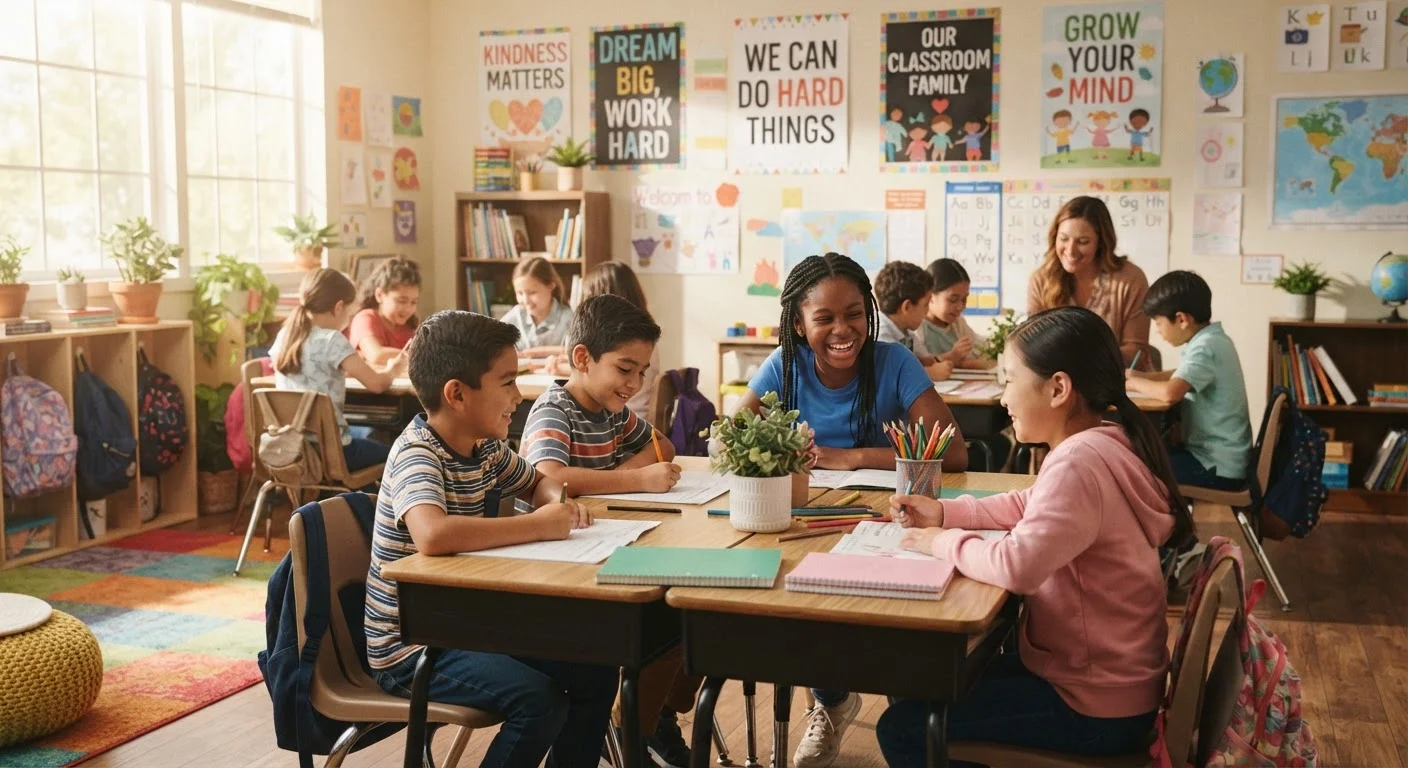
If your child's teacher has mentioned growth mindset in a newsletter or parent night, you're not alone in wondering what it means in practice — and whether it's more than just a motivational catchphrase. At its core, growth mindset is a framework for how children relate to challenge, difficulty, and failure.
In classroom settings, teachers use it to encourage students to persist through confusion, view errors as part of the learning process, and replace thoughts like "I can't do this" with "I can't do this yet." That small word — yet — carries significant weight. It signals that the current state isn't permanent.
Understanding this framing helps parents connect what's happening at school with what they say and do at home. Research consistently shows that mindset messages from parents are just as influential — sometimes more so — than those delivered in the classroom.
Growth Mindset Is Not 'Just Try Harder'
A common misunderstanding is that growth mindset simply means telling kids to work harder. In reality, it also involves teaching effective strategies, seeking help, and learning from feedback — effort alone isn't the whole picture. When children struggle despite genuine effort, they need better tools and support, not just more persistence.
The Praise Trap: Why Well-Intentioned Words Backfire
Most parents instinctively praise their children's achievements. But how you praise matters enormously. Saying "You're so smart!" after a good grade feels encouraging, but it quietly frames intelligence as a fixed trait — something your child either has or doesn't. When they later hit a hard problem, that identity becomes something to protect rather than a foundation to build on.
Process praise is the research-supported alternative. Phrases like "You kept trying even when it was frustrating" or "I noticed you tried a different approach when the first one didn't work" focus attention on what the child did, not what they are. This builds a mental model where effort and strategy — things within their control — are what drive growth.
Try Process Praise in Everyday Moments
You don't need a big achievement to practice process praise. Notice and name small efforts: finishing a puzzle despite frustration, trying a new food, or asking for help when stuck. These everyday moments add up to a consistent message that trying and learning matter more than instant success.
It's also worth noting that false praise backfires too. If a child puts in minimal effort and a parent responds with outsized enthusiasm, they'll sense the disconnect. Authentic, specific acknowledgment of real effort is far more effective than blanket positivity.
How Parents Accidentally Reinforce a Fixed Mindset
Even parents who understand the concept can slip into fixed-mindset messages without noticing. Some common patterns:
- Rescuing too quickly: Jumping in to solve a problem before a child has a chance to struggle removes the productive friction that builds resilience. See our guide to supporting a child through a hard school year for ideas on how to stay present without over-intervening.
- Labeling: Phrases like "She's just not a math person" or "He's always been the artistic one" assign fixed identities that children often internalize and act to confirm.
- Tying worth to outcomes: Treating a grade or performance as a reflection of who your child is — rather than what they produced — makes mistakes feel threatening to their sense of self.
Comparison is another subtle trap. It's natural to wonder how your child is doing relative to peers, but frequent comparison shifts focus away from individual growth. Our article on the pitfalls of comparing your child's development explores why this habit creates more anxiety than insight.
Making Growth Mindset Real at Home
The most powerful thing parents can do is model growth mindset rather than just teach it. When you share a mistake you made — at work, in a recipe, in a conversation — and talk through what you learned, you normalize the experience of imperfection for your child in a way no poster or lesson can.
2x
Improved motivation in growth mindset students
Research published in peer-reviewed psychology journals suggests students taught growth mindset principles show meaningfully greater motivation to persist through academic challenges compared to control groups.
~40%
Students who believe intelligence is fixed
Studies by Carol Dweck and colleagues found that a substantial proportion of school-age children hold fixed mindset beliefs about intelligence before any mindset intervention.
Some practical starting points:
- During homework, ask "What have you tried so far?" before offering help — this reinforces their role as the problem-solver.
- After a setback, try "What's one thing you'd do differently?" rather than focusing on what went wrong.
- Celebrate the effort that went into hard things, separate from whether they succeeded.
Building open communication with your child's teacher helps too — knowing what language and strategies the classroom is using lets you reinforce the same messages at home. Our parent's handbook for talking to teachers offers practical guidance for those conversations.
Growth mindset isn't a quick fix or a guarantee of academic success. But practiced consistently — with warmth and without pressure — it helps children develop a more durable relationship with learning itself. And that matters far beyond any single school year.