

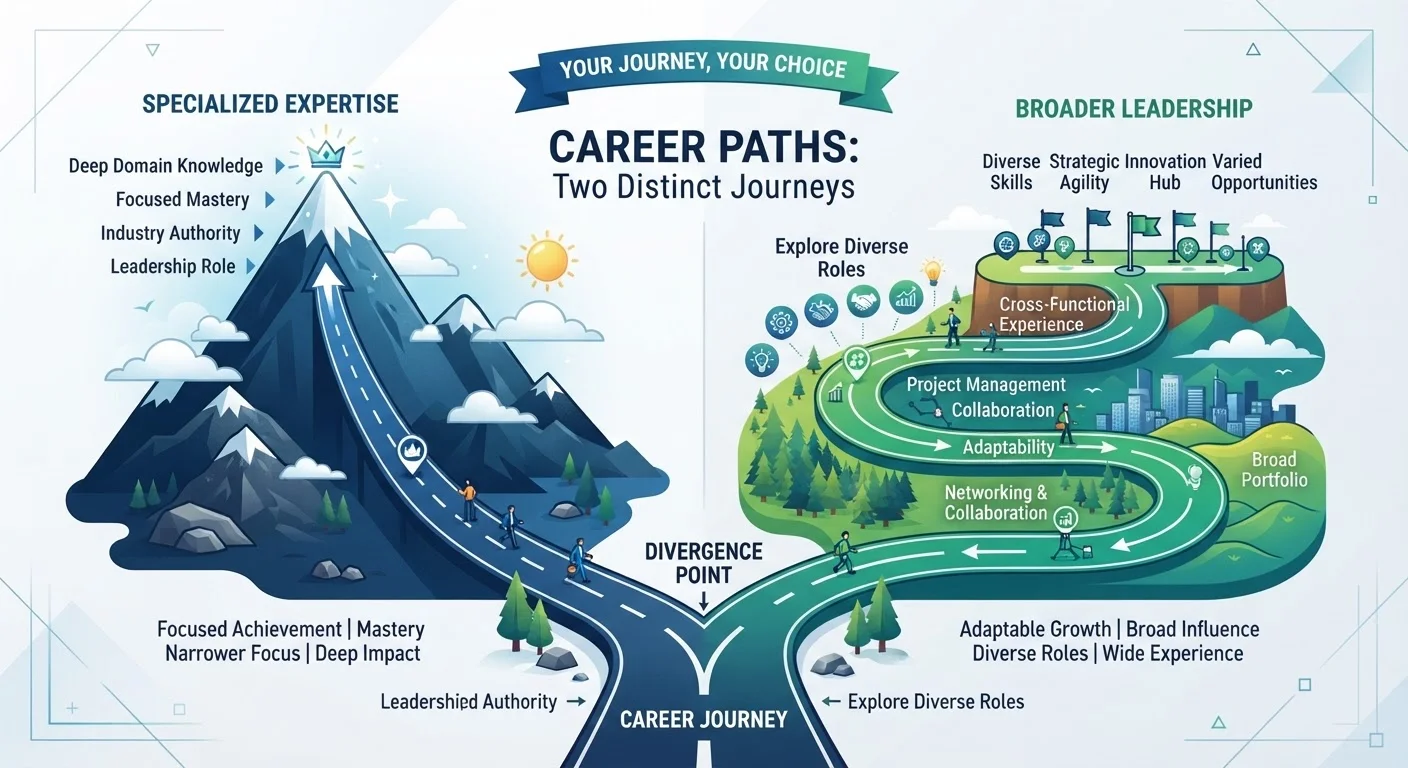
Key Takeaways
- Specialists often command higher pay in technical fields, but face greater risk if their niche shrinks or becomes automated.
- Generalists tend to be more adaptable and excel in leadership, cross-functional, and fast-changing environments.
- Most successful long-term careers blend elements of both — deep enough to be credible, broad enough to stay relevant.
- Industry context matters enormously: what pays off in healthcare differs from what works in tech or media.
- Neither path is permanent — deliberate pivots and skill-stacking can shift your shape at any career stage.
Our Verdict
Neither the specialist nor the generalist path is universally superior — the right choice depends on your industry, risk tolerance, and long-term goals. Specialists tend to win on compensation ceiling and technical authority in stable, high-demand niches, while generalists hold an edge in adaptability, leadership pipelines, and resilience across disruption. The most durable careers typically evolve from one toward the other over time, rather than staying rigidly in either camp.
| Best for | Recommended |
|---|---|
| Those in technical, regulated, or deeply niche fields | Specialist |
| Those targeting leadership, management, or cross-functional roles | Generalist |
| Early-career professionals building their foundation | Generalist first, then specialize |
| Mid-career professionals in volatile or fast-moving industries | T-shaped hybrid approach |
Defining the Two Career Shapes
A specialist builds deep expertise in one domain — a tax attorney, a machine learning engineer, a cardiac sonographer. Their value comes from knowing more about a narrow subject than almost anyone around them. A generalist builds competence across multiple domains — a chief of staff, a brand strategist, a project manager who moves between industries. Their value is contextual intelligence and adaptability.
In practice, pure versions of either are rare. Most people sit somewhere on a spectrum, and where you land — intentionally or by default — shapes your earning potential, job security, and career ceiling. Understanding the tradeoffs lets you make that call deliberately rather than drift into it.
For a grounding look at which underlying skills matter regardless of path, see our guide on hard skills vs. soft skills.
How Each Path Plays Out in the Labor Market
Specialists typically command a compensation premium when their expertise is in high demand and short supply. Fields like software engineering, medicine, and data science reward depth heavily — the more specific and scarce the knowledge, the higher the market rate. The risk is concentration: a niche that contracts, gets automated, or is offshored can leave specialists exposed with credentials that don't translate cleanly elsewhere.
Generalists tend to earn less early on but often grow faster into management, operations, and executive roles. They're seen as connective tissue in organizations — people who can translate between departments, manage cross-functional projects, and step into ambiguous roles. That adaptability becomes a significant asset during career pivots, where transferable skills are currency.
~$30K
Median pay gap: specialists vs. generalists
Research from the National Bureau of Economic Research has found that workers who specialize early can earn meaningfully more within their niche, though gains vary significantly by field and demand conditions.
65%
Executives with broad cross-functional backgrounds
Studies of Fortune 500 C-suite profiles suggest a majority of senior executives held roles across multiple functions before reaching the top, highlighting the leadership value of breadth.
Industry context reshapes these dynamics considerably. In large organizations with defined functional ladders, specialization is often the path to seniority. In startups or rapidly evolving fields, breadth gets you further faster. See how this plays out specifically in large organizations.
Specialist vs. Generalist: Head-to-Head
Comparing these paths directly shows where the real tradeoffs sit — and helps you identify which criteria matter most for your situation.
| Criterion | Specialist | Generalist | |
|---|---|---|---|
| Earning ceiling | Specialist | High in scarce, technical niches | Moderate unless reaching senior leadership |
| Job security | Generalist | Vulnerable if niche contracts or automates | More resilient across industry shifts |
| Promotion speed | Varies by industry | Slower without management track | Faster into cross-functional or leadership roles |
| Career pivotability | Generalist | Harder; credentials may not transfer | Easier; skills are more portable |
| Market differentiation | Specialist | High in field; scarce expertise stands out | Harder to stand out without a clear hook |
| Value in large organizations | Both | Strong in defined technical ladders | Strong in matrixed, cross-functional environments |
No single row determines the answer. Weigh the criteria most relevant to your industry, life stage, and risk appetite.
The T-Shaped Career: A Practical Middle Ground
The most widely cited framework for navigating this tension is the T-shaped professional — deep expertise in one area (the vertical bar) combined with working knowledge across adjacent domains (the horizontal bar). A UX designer who understands product strategy and basic engineering is more valuable than one who only knows design. A financial analyst who can communicate clearly and manage stakeholder relationships is easier to promote than one who only models spreadsheets.
Build Your T Intentionally
Don't wait for breadth or depth to accumulate by accident. Identify the one area where you want to be genuinely excellent, then map two or three adjacent domains worth understanding well. Treat both as active investments, not side effects of whatever project you happen to be on. Reviewing job postings for roles two levels above yours is a useful shortcut to see what combination the market is actually asking for.
This shape isn't just theoretical — it maps well to how hiring managers think. Early in your career, building the horizontal bar helps you understand context and collaborate effectively. Going deeper in a chosen area over time creates the credential and authority that opens higher-level doors. Our piece on skills for early-career professionals lays out which capabilities are worth investing in first.
The T-shape is also adaptable. If your niche starts to shrink, the horizontal bar gives you adjacent ground to move toward. If you've been too broad and feel undifferentiated, you can deliberately go deeper in one area without starting over.
Deciding Which Shape Fits You
Start by asking a few diagnostic questions:
- What does your industry reward? Some fields have narrow, well-paid expert tracks. Others reward leadership and breadth. Look at where people five to ten years ahead of you actually landed.
- What's your risk tolerance? Specialization concentrates risk. Generalism spreads it. Neither is inherently safer — they carry different kinds of exposure.
- Where are you now? Earlier in your career, breadth often serves you better. It's easier to specialize later than to broaden a CV that's been narrow for a decade.
- Are you targeting a move up or across? The answer changes your calculus. Lateral moves often favor generalist flexibility; vertical promotions in technical fields often demand demonstrated depth.
If you're weighing whether to stay and deepen where you are versus moving, staying put can itself be a strategic choice worth examining.