

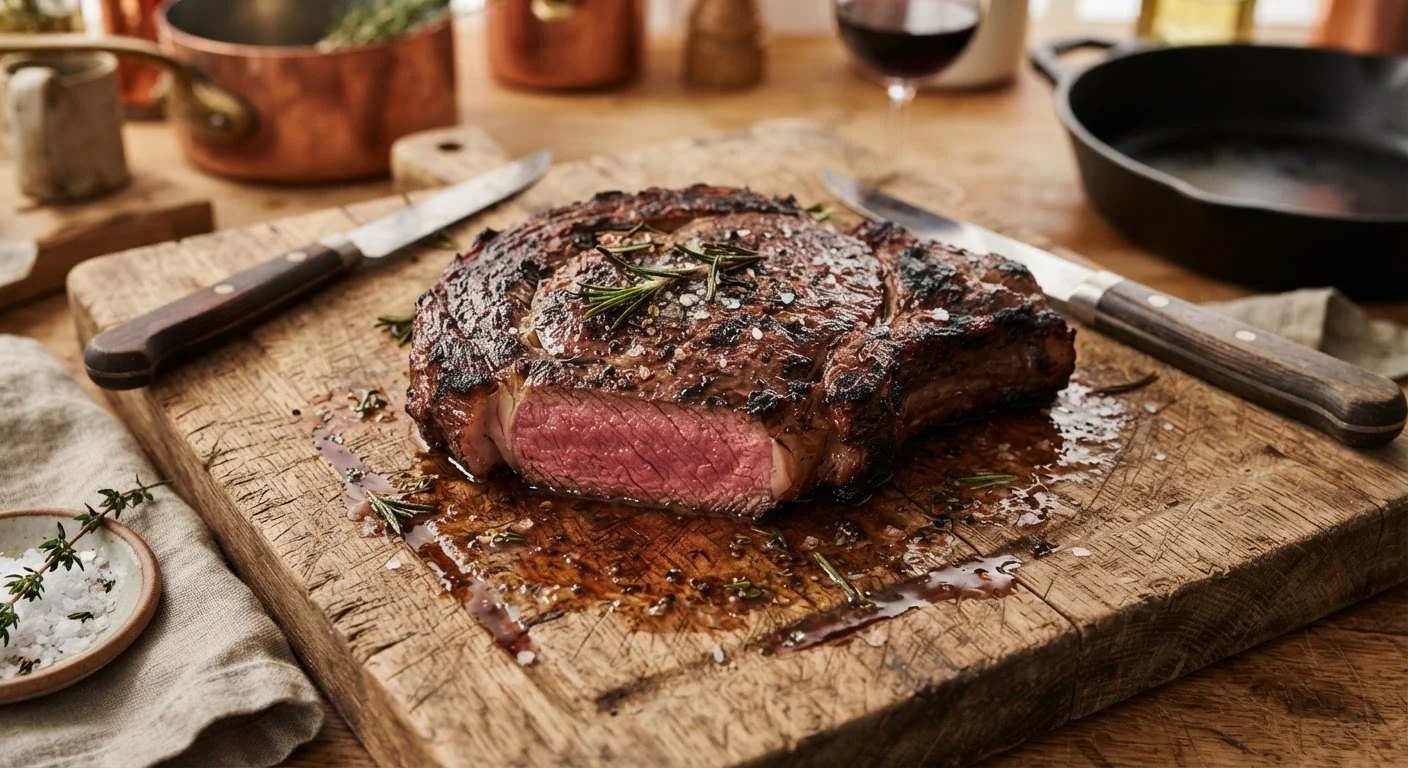
Key Takeaways
- Cutting meat too soon causes most of its internal moisture to spill onto the cutting board.
- Resting time varies by cut size — a thin chicken breast needs just 5 minutes, while a whole roast may need 20–30.
- Tenting loosely with foil during resting keeps meat warm without steaming the crust.
- Carryover cooking continues during resting, raising internal temperature by 5–10°F after heat is removed.
- Resting is one of the simplest techniques that consistently improves texture and juiciness.
Resting Meat
Resting meat means letting it sit off the heat for a short period before you cut into it. During cooking, heat drives moisture toward the center of the meat. Resting gives that moisture time to redistribute evenly throughout the cut, so less juice runs out when you slice it.
As internal temperature equalizes post-cooking, muscle fibers that contracted under heat begin to relax slightly, allowing liquid trapped at the core to migrate back toward the outer layers.
What Happens Inside Meat During Cooking
When meat hits a hot pan or oven, its muscle fibers contract rapidly in response to heat. This contraction squeezes moisture — primarily water and dissolved proteins — away from the outer layers and toward the cooler center of the cut. Think of it like wringing out a sponge: the fibers tighten and push liquid inward.
The longer and hotter the cooking, the more pronounced this effect. By the time your steak reaches your preferred internal temperature, the moisture inside is unevenly distributed — concentrated at the core and depleted near the surface.
Understanding Carryover Cooking
After you pull meat from heat, its internal temperature continues to climb — often 5–10°F — as residual heat moves inward. Accounting for this helps you pull meat at the right moment rather than accidentally overcooking it during the rest. For a 1-inch steak aimed at 130°F (medium-rare), pulling at 122–125°F and resting typically lands it right where you want it.
This is also why carryover cooking matters. After you pull meat from heat, its internal temperature continues to climb — often 5–10°F — as residual heat moves inward. Accounting for this helps you pull meat at the right moment rather than accidentally overcooking it during the rest.
What Resting Actually Accomplishes
Resting gives muscle fibers time to relax and the pressure gradient inside the meat to equalize. As the temperature evens out, moisture migrates back from the center toward the outer edges. The result: a more uniformly juicy cut from edge to edge.
If you skip this step, that redistribution happens on your cutting board instead of inside the meat. Anyone who's sliced into a steak straight off the grill and watched a puddle of liquid form can confirm this firsthand.
Resting Improves Texture, Not Just Juiciness
Relaxed muscle fibers are slightly more tender than fibers still contracted from heat. Even a short rest of 5 minutes on a thin cut makes a noticeable difference in mouthfeel. Build the rest time into your plating routine so it never feels like waiting.
Resting doesn't only affect moisture — it also improves texture. Relaxed muscle fibers are slightly more tender than fibers that are still contracted from heat, so the difference in mouthfeel is real, even if subtle.
How Long Different Cuts Actually Need
Resting time scales with the size and thickness of the cut. Here's a practical breakdown:
- Thin cuts (chicken breast, pork chop, fish fillet): 3–5 minutes
- Steaks (3/4 to 1 inch thick): 5–8 minutes
- Thick steaks and chops (1.5 inches or more): 8–10 minutes
- Whole roasted chicken or duck: 15–20 minutes
- Large roasts (beef rib roast, pork shoulder): 20–30 minutes
A common rule of thumb is roughly one minute of resting per 100 grams of meat, though this is a guide rather than a strict formula. The key variable is mass — more meat holds more heat and needs more time for temperatures to stabilize.
5–10°F
Temperature rise from carryover cooking
Internal temperature continues to increase after meat is removed from heat, making pull-point timing important.
~40%
Less juice lost when meat is properly rested
Food science demonstrations consistently show that rested cuts retain significantly more moisture than cuts sliced immediately.
Practical Tips for Resting Meat Well
A few simple habits make resting more effective:
- Transfer to a warm plate or board. A cold surface pulls heat out of the meat faster. A room-temperature wooden cutting board or a plate warmed briefly in the oven (then cooled slightly) helps retain warmth.
- Tent loosely with foil. This slows heat loss without trapping steam, which would soften a crust or sear. Avoid sealing the foil tightly.
- Don't pierce or press the meat. Poking or pressing during rest releases the moisture you're trying to preserve.
Resting pairs naturally with other foundational techniques. Just as timing affects the outcome here, the stage at which you add salt also has a real impact on moisture and texture — see our guide to salting at the right time for how these fundamentals work together.