

Key Takeaways
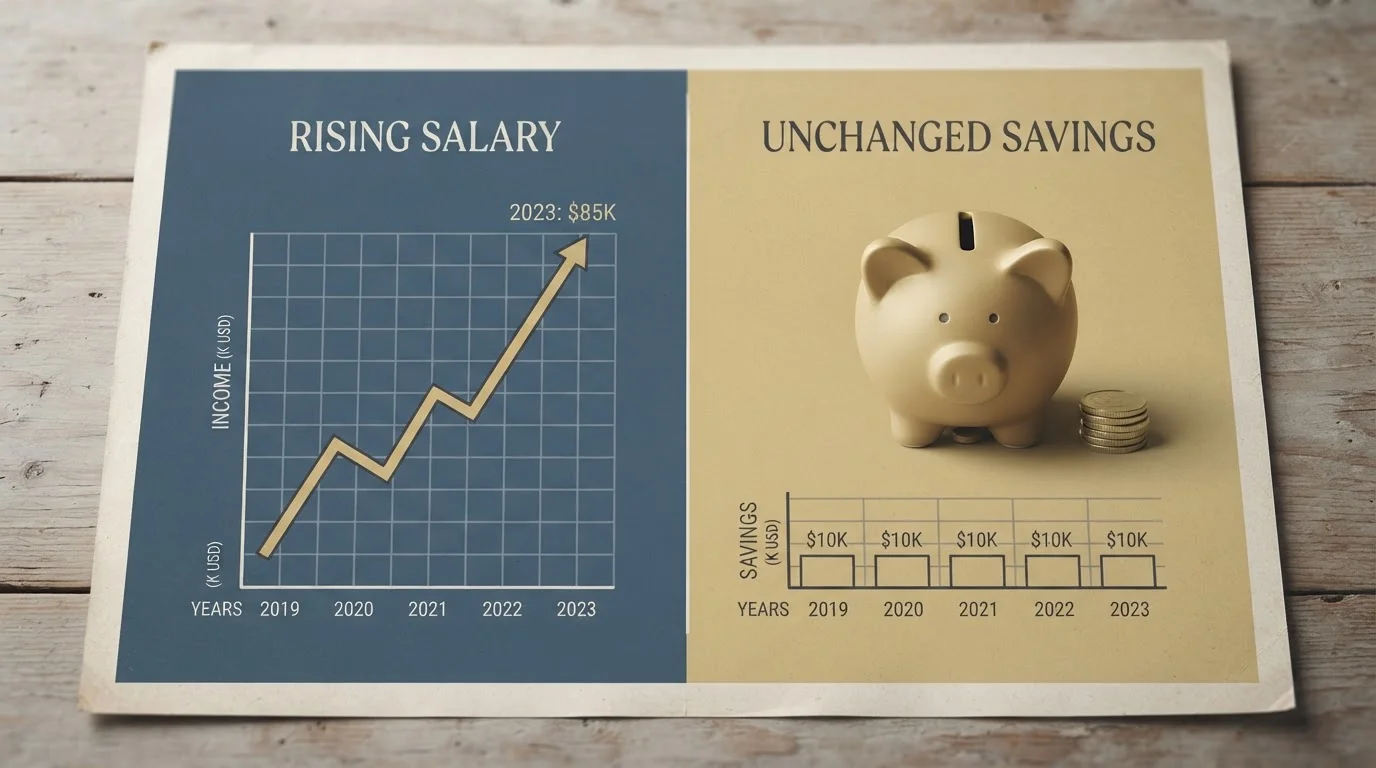
- Lifestyle inflation is a documented behavioral pattern that grows spending alongside income.
- Psychological factors — not just math — explain why raises rarely improve financial security on their own.
- Automating savings before spending is one of the most evidence-backed ways to close the gap.
- Social comparison and identity spending are major drivers of inflated expenses after a pay increase.
- Deliberate budgeting decisions must accompany income growth to build lasting financial stability.
The Income-Savings Gap Is Real — and Common
Most people expect a straightforward relationship between earning and saving: earn more, save more. It makes intuitive sense. But data and behavioral research tell a more complicated story.
Across income levels, Americans report difficulty building financial cushions — not primarily because they earn too little, but because spending tends to expand alongside income. This isn't a niche problem or a sign of personal failure. It's a documented behavioral pattern that affects households well into six-figure incomes.
Understanding why this happens — rather than just telling yourself to try harder — is what makes it possible to actually change. This article unpacks the most common myths about income and saving, and replaces them with what the evidence actually shows.
Myth
Once I earn more, saving will naturally follow. I just need a higher income.
Fact
Saving rates tend to stay flat or even decline when income rises without intentional planning, a pattern researchers call lifestyle inflation.
The assumption that saving becomes automatic with higher income is one of the most persistent myths in personal finance. Behavioral economists have documented that people tend to expand their spending in proportion to new income rather than bank the difference. This is sometimes called lifestyle inflation or lifestyle creep — and it operates largely below conscious awareness. Without a deliberate decision to redirect new money toward savings, most of it gets absorbed by upgraded habits, larger purchases, and subtle increases in day-to-day spending. See how lifestyle creep works in practice for a closer look at the pattern.
Myth
People who earn a lot but save little must simply be irresponsible with money.
Fact
Spending behavior is shaped by powerful psychological and social forces — not just personal discipline or character.
Framing overspending as a character flaw misses the real mechanism at work. Social comparison — keeping pace with colleagues, neighbors, or peers whose spending reflects a higher income bracket — is a well-studied driver of financial decision-making. When income rises, reference groups often shift upward too, pulling spending with them. Identity spending (buying things that signal status or success) also intensifies after a promotion or raise. These aren't signs of weakness; they're predictable human responses to social context. Understanding them is the first step to countering them. Recognizing subtle self-sabotage patterns can help you spot these forces in your own behavior.
Myth
A raise is the best time to improve your financial situation.
Fact
A raise is an opportunity — but only if you act on it deliberately before new spending habits form.
A pay increase does create a genuine window for financial improvement, but that window closes quickly. Research in behavioral finance suggests that spending adjustments happen fast and tend to stick. The most effective approach is to redirect a portion of any raise into savings or debt repayment before it hits your checking account — ideally through automatic transfers or increased retirement contributions. This leverages inertia in your favor rather than against you. Principles for building consistent savings habits explains why automation is so effective at closing the gap.
Myth
Budgeting only matters when money is tight.
Fact
Budgeting is more important — not less — when income grows, because more money means more potential for unnoticed spending drift.
It's tempting to think budgets are a tool for scarcity. In practice, they're most powerful as income scales up. Higher earners have more transactions, more discretionary categories, and more opportunities for spending to drift upward in ways that are individually small but collectively significant. A clear budgeting framework gives you a baseline so you can actually see what's changed — and decide intentionally what should change — rather than discovering the drift months later. Without that visibility, income growth can quietly fund a more expensive lifestyle without moving you any closer to financial goals.
What You Can Actually Do About It
Acknowledging that income growth doesn't automatically improve financial security isn't cause for pessimism — it's an invitation to be deliberate. A few practical principles hold up across a wide range of financial situations:
- Automate first. When a raise or bonus arrives, set up automatic transfers to savings or retirement accounts before adjusting your spending. What you don't see in your checking account, you're unlikely to miss.
- Set a savings rate, not a savings amount. A fixed percentage of income scales naturally as earnings grow, keeping saving proportional rather than flat. For guidance on building savings and managing debt, foundational resources are available.
- Watch for identity spending. After a promotion, pay attention to purchases that feel like they're about signaling your new status rather than genuine preference. There's nothing wrong with rewarding yourself — but doing it consciously costs less than doing it on autopilot.
- Revisit your budget after every income change. Treat each raise as a prompt to reallocate, not just a reason to relax. Consider how your financial mindset evolves over time and whether your saving behavior is keeping pace.
Raises Can Mask Financial Vulnerability
A higher paycheck can create a false sense of security. If spending rises in lockstep with income, your financial cushion — the gap between what you earn and what you spend — stays the same or even shrinks. Don't mistake a bigger number on your pay stub for genuine financial progress.
This article is for general informational and educational purposes only and does not constitute personalized financial advice. Please consult a qualified financial professional before making decisions about your own finances.