

Why Money Mindset Changes Over Time
Your relationship with money isn't fixed. It bends under the weight of life experience — first jobs, family obligations, market downturns, and eventually, the finish line of a career. Behavioral economists have long noted that financial attitudes are deeply tied to life stage, not just income level. Understanding how those attitudes typically shift can help you recognize your own patterns before they quietly run the show.
It's also worth remembering that the money beliefs you carry today may trace back further than you think. Inherited financial beliefs from childhood have a way of persisting into adulthood, often shaping decisions we assume are purely rational.
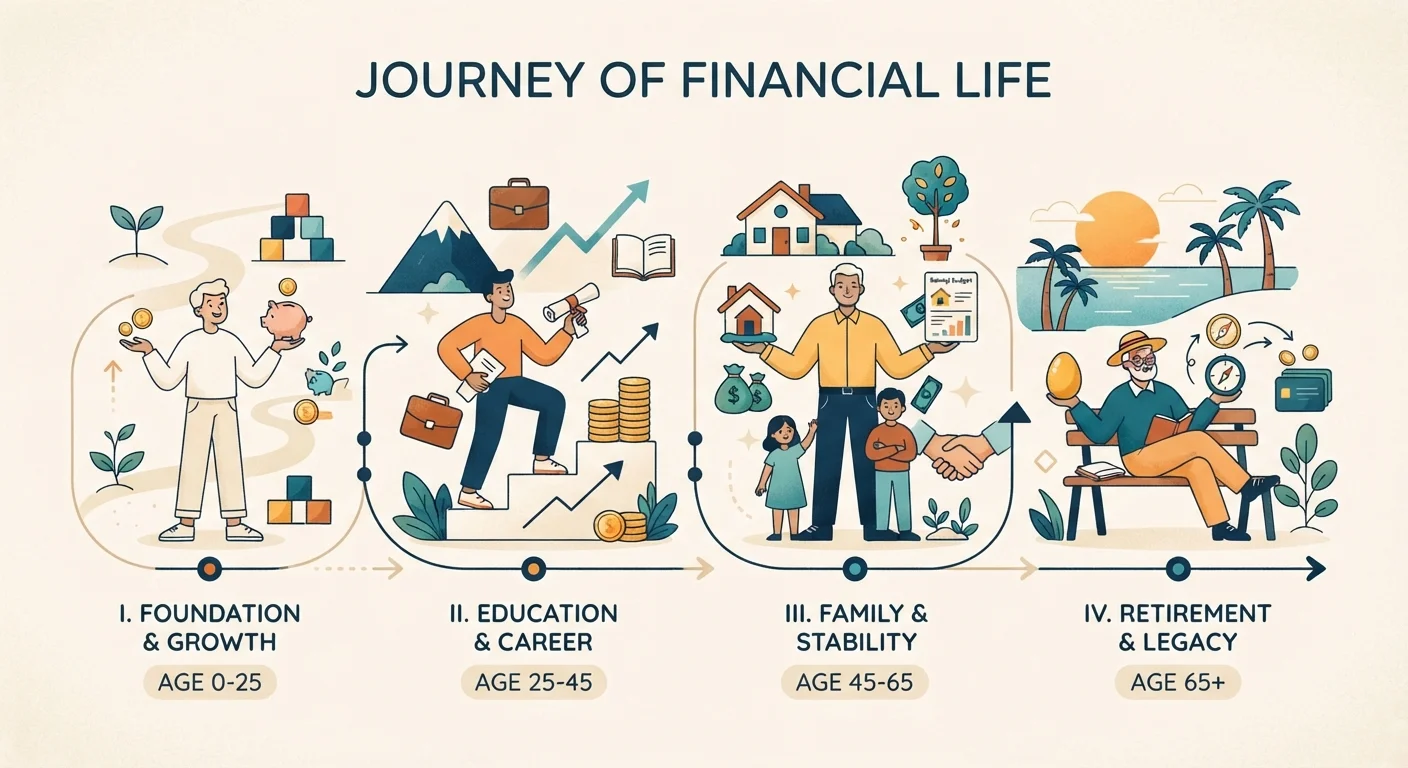
The Four Broad Stages — and What Drives Each
Your Twenties: Building and Experimenting
Early adulthood tends to be defined by financial firsts — first paycheck, first credit card, first rent payment. The dominant mindset here is often short-term and exploratory. Many people in this stage feel simultaneously optimistic and overwhelmed. Research in behavioral finance suggests that present bias — overweighting immediate rewards versus future ones — is especially strong in younger adults. This can make saving feel abstract and spending feel immediate.
That said, the twenties carry a structural advantage: time. Compound growth rewards early, even modest, contributions to savings or retirement accounts. The challenge is getting the mindset to catch up to the math. If you want to dig deeper into why higher income later doesn't automatically solve this, see why earning more doesn't always mean saving more.
Your Thirties and Forties: Accumulation Under Pressure
This stage often brings peak financial complexity. Mortgages, children, aging parents, career pivots — the demands multiply. The dominant mindset can swing between ambition and anxiety. People in this range tend to compare themselves more to peers, which can accelerate lifestyle creep even as incomes rise.
Cognitive load is real here. When mental bandwidth is stretched thin, financial decisions often default to habit or inertia rather than intention. This is precisely when basic budgeting structures provide the most stability — not because the math is complex, but because having a system reduces decision fatigue.
Your Fifties: Recalibration and Reality Checks
The fifties often bring a clearer view of the horizon. Retirement is no longer abstract. Many people in this stage shift from accumulation mode to preservation mode — sometimes too abruptly. Loss aversion, a well-documented cognitive bias, tends to intensify with age, which can cause overly conservative financial behavior that undermines long-term security.
This is also a stage where earlier mindset patterns surface with clarity. Someone who consistently avoided looking at account balances in their thirties may find that avoidance has compounded. Conversely, those who built intentional habits earlier often find this decade less frightening. Auditing your money mindset at this stage can be especially clarifying.
Retirement: Spending After a Lifetime of Saving
Perhaps the most counterintuitive shift happens at retirement. After decades of accumulating, many retirees find it psychologically difficult to spend. Studies have shown that some retirees underspend their assets significantly, even when financially secure, due to fear of running out. The saving mindset, once useful, can become a barrier to actually enjoying what was built.
Delayed gratification is a virtue for most of your working life — but in retirement, the calculus changes. Reframing money as a tool to fund a meaningful life, rather than a score to protect, is a genuine psychological adjustment many retirees benefit from working through with a qualified financial adviser.
Shifting Your Mindset Is Always Within Reach
No matter your stage, mindset isn't destiny. The patterns described above are tendencies, not sentences. Understanding the psychological forces at play in your current stage is the first step toward making more intentional choices. If you want a structured approach to examining and changing your financial narrative, reframing your money narrative is a practical place to start.
And if you're working on building healthier financial habits from scratch or after a setback, building a healthier relationship with money offers a values-based framework that applies at any age.
This article is for general informational and educational purposes only and does not constitute personalized financial, investment, tax, or legal advice. For guidance specific to your situation, consult a qualified financial professional.