

Key Takeaways
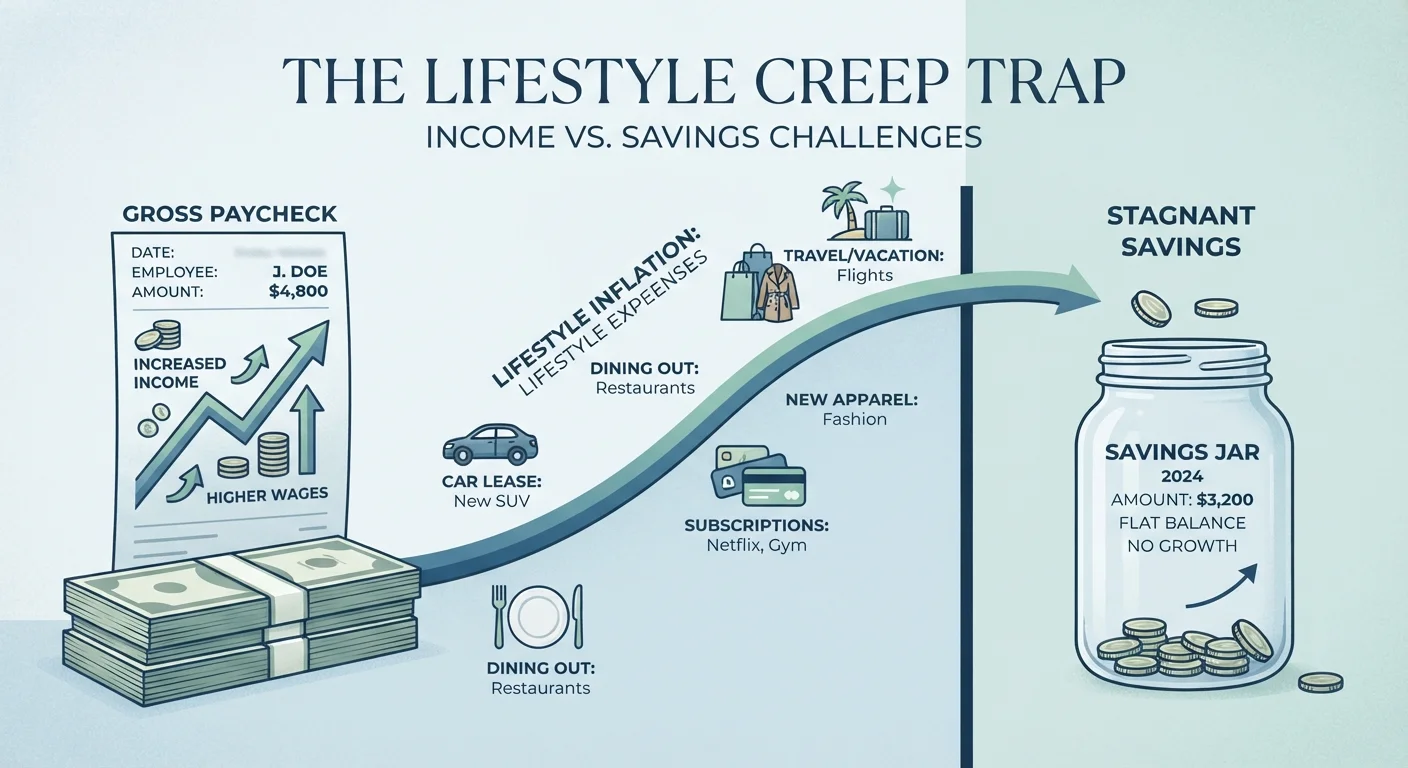
- Lifestyle creep happens when spending rises in step with — or faster than — income, leaving savings unchanged.
- Small, incremental upgrades to everyday spending are the most common and least noticeable form of creep.
- Automating savings before discretionary spending reaches your checking account is a proven counter-strategy.
- Social comparison and normalizing 'treats' after raises are key psychological drivers of lifestyle inflation.
- Recognizing creep early is the first step — it requires revisiting your spending regularly, not just when there's a problem.
Lifestyle Creep
Lifestyle creep (also called lifestyle inflation) is the gradual process of spending more as your income rises, so that your savings rate stays flat or even shrinks despite earning a higher paycheck. What once felt like a luxury — restaurant dinners, a newer car, a bigger apartment — quietly becomes the new normal. The result is that financial progress can stall even when earnings improve.
Behavioral economists describe this as a form of hedonic adaptation: the tendency for people to return to a baseline level of satisfaction after income gains, which drives consumption upward rather than wealth accumulation.
What Lifestyle Creep Looks Like in Practice
Picture this: you land a $10,000 raise. You upgrade your apartment, start ordering takeout more often, replace a functional car with a newer model, and pick up a couple of streaming subscriptions. None of these decisions feels reckless on its own. But by the end of the year, your monthly expenses have risen by roughly $800 — and your savings account looks almost identical to what it did before the raise.
That's lifestyle creep. It's rarely one dramatic splurge. It's a slow accumulation of small upgrades that each feel reasonable in isolation but collectively absorb most of a pay increase before it can do any lasting financial work.
Because lifestyle creep is gradual, it's easy to miss. The pattern of income growth failing to improve financial security is well-documented — but most people don't notice it in their own lives until they look back over several years and realize their savings haven't budged much despite earning significantly more.
The Psychology Behind the Spending Creep
Two forces make lifestyle creep particularly sticky. The first is hedonic adaptation — the brain's tendency to normalize new circumstances. The upgraded apartment that felt luxurious in month one feels ordinary by month six. The same mechanism that made a raise exciting pushes you toward the next upgrade once the initial thrill fades.
The second is social comparison. Spending norms shift as income rises and peer groups change. If your colleagues take business-class flights or frequent upscale restaurants, spending at that level starts to feel standard rather than extravagant. These aren't character flaws — they're well-documented features of human psychology. Understanding them matters because it helps you spot the pattern before it takes hold.
“We buy things we don't need with money we don't have to impress people we don't like.”
— Will Rogers, American humorist and social commentator
Lifestyle creep also intersects with deeply held money beliefs. Many people grew up hearing that financial success should look a certain way — a nice car, a comfortable home, regular vacations. Financial beliefs absorbed in childhood often amplify the impulse to upgrade spending as a visible marker of having "made it."
How to Recognise and Counter Lifestyle Creep
The most reliable check is tracking your savings rate — the share of your income that goes to savings or debt paydown — rather than the raw dollar amount saved. A savings rate keeps score honestly: if income doubles and the savings rate stays the same, you are not getting ahead in proportion to your earning power.
Automate Before You Spend
When your income increases, set up an automatic transfer to savings or a debt payment account before updating any discretionary spending. Even redirecting 50% of a raise this way means you still have more to spend — while making measurable progress toward financial goals. Small, consistent automations compound significantly over time.
A practical counter-strategy: treat raises and bonuses as savings events first. Before the extra income touches your checking account, redirect a defined portion — many financial educators suggest at least half of any raise — into savings or debt repayment. This approach, sometimes called paying yourself first, is one of the core principles explored in building a savings habit that actually sticks.
It's also worth building a regular spending review into your routine — quarterly is manageable for most people. Compare current spending in each category against what you were spending before a raise. Categories that have expanded without a conscious decision are the clearest signal of creep in action. If you find yourself avoiding this kind of review, that avoidance itself is worth examining — it's one of the more subtle ways people work against their own financial progress.
~70%
Americans living paycheck to paycheck
Surveys by LendingClub and PYMNTS.com have consistently found that a large majority of U.S. consumers — across income brackets — report spending most of their monthly income, underscoring how widespread lifestyle inflation is regardless of earnings level.
Less than 5%
Average U.S. personal savings rate in recent years
According to Federal Reserve Economic Data (FRED), the U.S. personal saving rate has frequently hovered below 5% in recent years, a historically low level that suggests many households are not converting income growth into savings growth.
None of this means you can't enjoy the fruits of higher earnings. The goal isn't to live as if you never got a raise — it's to make intentional choices about where extra income goes rather than letting spending expand on autopilot. For more tools on keeping day-to-day spending in line with your goals, the Budgeting Basics hub is a useful starting point.