

Key Takeaways
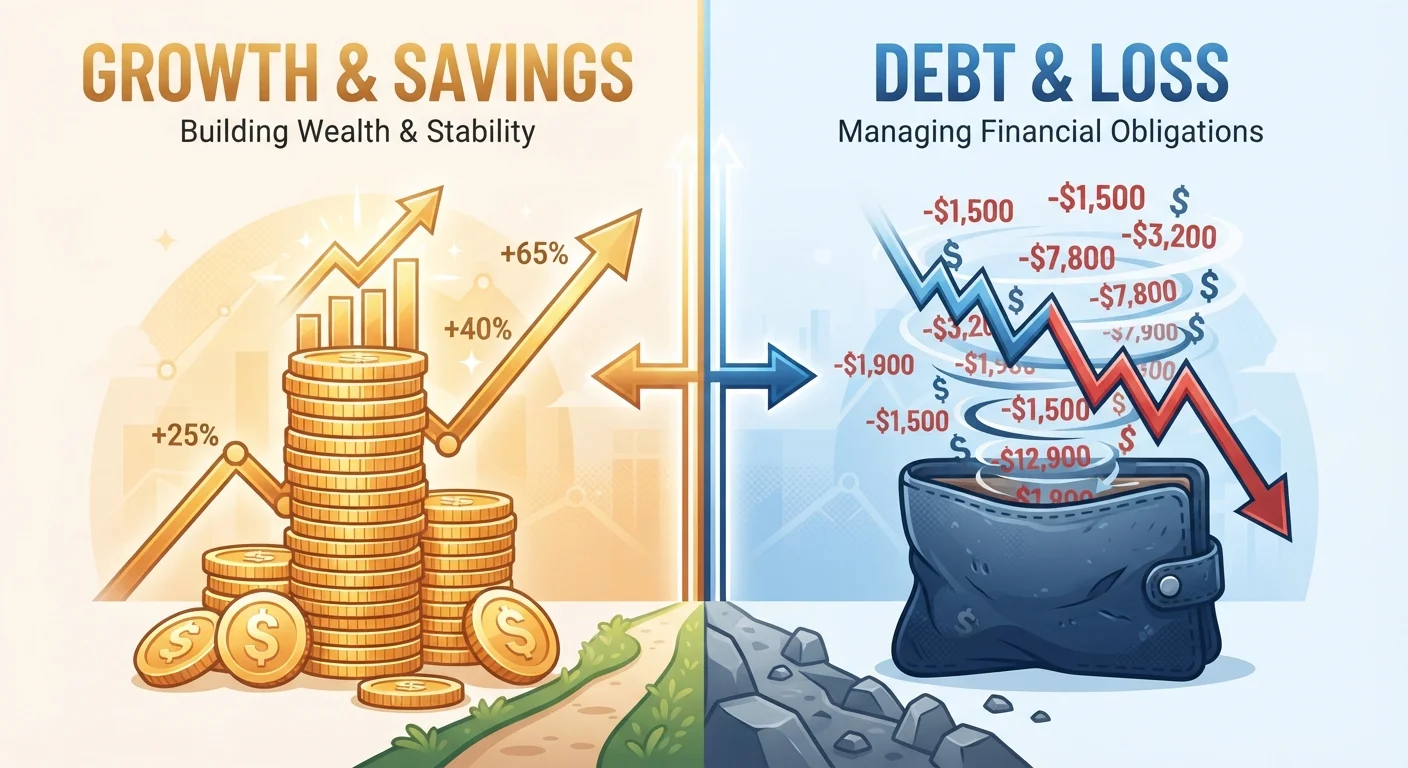
- Compound interest grows both savings and debt — the math works the same way in both directions.
- Starting to save earlier, even with small amounts, produces significantly larger results over time.
- High-interest debt compounds against you quickly; paying it down faster reduces total costs substantially.
- Compounding frequency matters — daily compounding grows (or costs) more than annual compounding at the same rate.
- Time is the most powerful variable in the compound interest equation.
Compound Interest
Compound interest is interest calculated not just on the original amount of money (called the principal), but also on the interest that has already accumulated. In plain terms: you earn interest on your interest — or, if you're in debt, you owe interest on your interest. Over time, this creates a snowball effect that can dramatically grow both savings and debt balances.
The compounding frequency — daily, monthly, or annually — affects how quickly the effect accelerates. More frequent compounding periods mean faster growth (or faster accumulation of debt costs).
How Compound Interest Actually Works
Imagine you deposit $1,000 into a savings account earning 5% annual interest. After year one, you've earned $50 in interest — straightforward enough. But in year two, you earn 5% on $1,050, not just the original $1,000. That extra $2.50 seems trivial, but as years stack up, the effect becomes pronounced.
After 30 years at 5% annually, that $1,000 grows to roughly $4,322 — more than four times the original amount, without adding another dollar. This is compounding at work: each period's interest becomes part of the principal for the next period.
4.3x
Growth of $1,000 at 5% over 30 years
Calculated using standard compound interest formula at 5% annual rate, compounded annually, with no additional contributions.
~22%
Average credit card APR in the U.S.
According to Federal Reserve data on credit card interest rates for accounts assessed interest, rates have hovered near or above 20% in recent years.
72 ÷ rate
Rule of 72: years to double money
A widely used mental shortcut in financial education — divide 72 by your annual return to estimate doubling time. At 6%, money roughly doubles in 12 years.
The compounding frequency also matters. When interest compounds daily rather than annually, you're effectively earning interest on interest every single day. At identical stated rates, daily compounding produces a modestly higher effective annual yield — a detail worth checking when comparing savings accounts or loan terms.
When Compounding Works Against You
The same math that quietly builds a savings balance also quietly inflates debt. Credit cards are the most common example most Americans encounter. If you carry a $3,000 balance on a card with a 20% annual percentage rate (APR), the issuer typically compounds interest daily. By the end of a year of minimum payments, you've paid hundreds of dollars — much of it going toward interest rather than reducing what you owe.
Student loans and personal loans can compound in similar ways, depending on their terms. The key insight: the higher the interest rate and the longer the balance lingers, the more punishing compounding becomes.
Extra Payments Cut More Than You Think
Because interest compounds on your remaining balance, reducing that balance faster has a multiplying effect. Even modest extra payments made consistently — say, rounding up your monthly payment — reduce the principal faster and shrink every future interest calculation. Small actions early in a loan's life have more impact than the same actions made late.
This is why financial educators often frame paying down high-interest debt as a guaranteed "return" on your money. Eliminating a 22% APR credit card balance is functionally equivalent to earning a 22% return — without any investment risk. For a fuller look at how to weigh these competing priorities, see Saving vs. Paying Off Debt: Which Should Come First?.
The Time Variable: Why Starting Early Matters So Much
Of all the inputs in the compounding equation — principal, rate, and time — time is the one most people underestimate. Two people saving the same annual amount at the same interest rate will end up with dramatically different balances if one starts a decade earlier.
Consider two savers, both earning 6% annually. One starts at age 25 and saves for 10 years, then stops entirely. The other starts at 35 and saves continuously for 30 years. In many modeled scenarios, the earlier starter ends up with a larger balance at retirement — despite contributing far less total money — simply because their money had longer to compound.
This dynamic is sometimes called the "cost of waiting." Delaying savings by even a few years meaningfully reduces the total compounding runway. That's not meant to shame anyone who started late — it's a practical reason to begin (or resume) saving as soon as possible, with whatever amount is available. Consistency tends to matter more than the dollar amount early on, a point explored in Making Your Savings Habit Stick.
“Compound interest is the eighth wonder of the world. He who understands it, earns it; he who doesn't, pays it.”
— Commonly attributed to Albert Einstein, This quote is widely cited in financial education contexts; its precise origin is debated, but the principle it describes is mathematically sound.
Putting It Into Practice
Understanding compound interest changes how you evaluate financial decisions. A few practical implications worth keeping in mind:
- On savings: Even small, consistent contributions to an interest-bearing or investment account benefit from compounding. Automate contributions if possible — consistent habits reduce the friction that leads to delays.
- On debt: Any extra payment above the minimum reduces your principal, shrinking the base that compounds interest going forward. Paying even $25 extra per month on a credit card balance has a real and measurable impact over time.
- On decision-making: If you're weighing whether to consolidate or restructure debt, one factor worth examining is how the new interest rate and compounding terms compare to what you currently carry. See Debt Consolidation: What Actually Changes and What Doesn't for a grounded look at how that works.
Compounding Applies to Investments Too
While this article focuses on savings accounts and debt, the same compounding principle applies to investment returns — including retirement accounts like 401(k)s and IRAs. Investment returns are not guaranteed, and past performance doesn't predict future results, but the mathematical structure of compounding is why long investment time horizons are generally considered advantageous. Speak with a licensed financial advisor about what makes sense for your situation.
This article is general financial education — not personalized advice. Everyone's debt load, income, and goals are different. A licensed financial professional can help you develop a plan suited to your specific circumstances.
This article is for informational purposes only and does not constitute personalized financial, investment, or tax advice. Please consult a qualified financial professional for guidance tailored to your situation.