

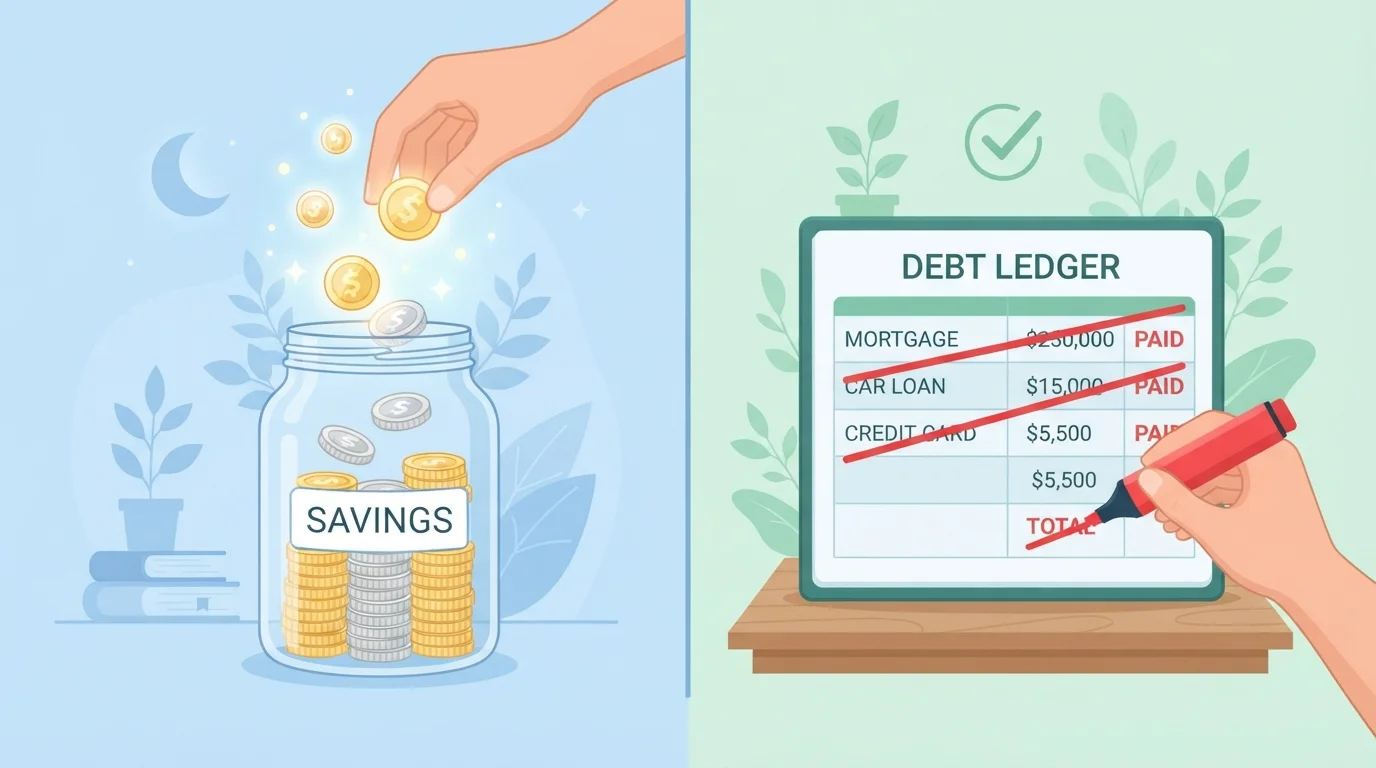
Key Takeaways
- A small emergency fund — even $1,000 — can prevent new debt from derailing your payoff progress.
- High-interest debt typically costs more than savings earn, making repayment the stronger mathematical move.
- Employer retirement matches are essentially free money and usually worth capturing before aggressively paying debt.
- Most people benefit most from a hybrid approach rather than choosing one path exclusively.
- Your interest rates are the key number: compare what debt costs against what savings reliably earn.
Option A
Building Savings First
The financial cushion approach — protect yourself before attacking debt.
Best for: People with no emergency fund, those with low-interest debt, or anyone whose employer offers retirement matching contributions.
Option B
Paying Off Debt First
The interest-elimination approach — stop the bleeding before saving.
Best for: People carrying high-interest debt (such as credit cards) where interest charges outpace any realistic savings return.
If you have no emergency fund at all
Building Savings First
Without any cushion, an unexpected expense forces you onto a credit card, creating new debt. A starter fund of $500–$1,000 provides a crucial buffer before you shift focus to aggressive debt payoff.
If you're carrying high-interest credit card debt
Paying Off Debt First
Credit card APRs commonly exceed 20%, far outpacing what savings accounts return. Every dollar applied to that balance saves more than it would earn sitting in a savings account.
If your employer offers a retirement contribution match
Building Savings First
Capturing a full employer match is a 50–100% instant return on contributed dollars, which mathematically beats paying down even moderately high-interest debt.
If your debt is low-interest (student loans, mortgage)
Building Savings First
When loan interest rates are relatively low, saving and investing can generate comparable or greater long-term returns, making parallel progress sensible.
If you want a single clear-cut strategy
Paying Off Debt First
Eliminating debt guarantees a fixed return equal to the interest rate avoided — no market risk involved. It also frees up cash flow permanently once balances hit zero.
Why This Decision Is Harder Than It Looks
On the surface, the math seems obvious: if your debt charges more interest than your savings earn, pay off the debt. But personal finance isn't purely arithmetic. Real decisions involve job security, family obligations, psychological stress, and the very real risk that a single unplanned expense can wipe out months of progress.
The tension between saving and debt payoff is one of the most common financial dilemmas American households face. According to Federal Reserve survey data, a significant share of adults carry revolving credit card balances while simultaneously holding little or no liquid savings. That combination — expensive debt alongside an empty cushion — is where the decision gets genuinely complicated.
Understanding how compound interest works for and against you is the foundation of this decision. When interest compounds on debt, you owe more with each passing month you don't pay it down. When it compounds in savings, your balance grows. The direction matters enormously.
| Criterion | Building Savings First | Paying Off Debt First |
|---|---|---|
| Primary benefit | Financial safety net, reduces risk | Eliminates interest charges guaranteed |
| Best when debt interest rate is | Low (e.g., below 5–6%) | High (e.g., credit cards 15%+) |
| Risk of unexpected expense | Lower — cushion absorbs shocks | Higher — may force new debt |
| Return on each dollar | Variable, market-dependent | Fixed, equals the interest rate avoided |
| Employer match consideration | Captures free matching dollars | May sacrifice match while paying debt |
| Psychological effect | Sense of security and stability | Motivation from shrinking balances |
| Long-term outcome | Savings grow; debt persists longer | Debt gone; cash flow freed sooner |
The Case for Saving First
Financial planners widely recommend establishing a basic emergency fund before making aggressive debt payments — and the reasoning is practical, not counterintuitive. Without liquid savings, any disruption (a car repair, a medical bill, a gap between jobs) lands directly on a credit card, potentially generating new high-interest debt faster than you can retire the old balance.
A starter emergency fund of roughly $500 to $1,000 is often cited as a meaningful first target. It won't cover every crisis, but it intercepts the most common ones. From there, you can redirect energy toward debt while building toward a fuller three-to-six-month cushion over time.
The other scenario where saving wins clearly: employer-sponsored retirement plans with matching contributions. If your employer matches, say, 50 cents on every dollar you contribute up to 6% of salary, declining that match to pay debt faster means walking away from compensation you've already earned. That's a guaranteed return no debt payoff strategy can replicate. See our starter's roadmap to building savings from scratch for practical first steps.
~37%
U.S. adults carrying credit card debt month-to-month
According to Federal Reserve Board surveys on household finances, a substantial share of American adults revolve a credit card balance rather than paying it off in full each month.
$400
Emergency expense many adults couldn't cover in cash
Federal Reserve consumer finance research has found that a notable share of U.S. adults would struggle to cover a modest unexpected expense without borrowing or selling something.
20%+
Average credit card APR in recent years
Federal Reserve data on consumer credit shows average credit card interest rates have remained well above 19–20% APR, making credit card debt among the costliest common forms of consumer borrowing.
The Case for Paying Off Debt First
When debt carries a high interest rate, paying it down produces a guaranteed, risk-free return equal to the rate itself. A credit card charging 22% APR means every $100 you apply to that balance effectively returns $22 per year — a rate no federally insured savings account currently matches.
This is the core mathematical argument for prioritizing debt repayment. High-interest balances grow relentlessly. Even disciplined savers can find their net worth eroding if the interest accumulating on debt outpaces the interest growing in savings.
There's also a behavioral dimension. Carrying debt creates ongoing financial stress that can impair decision-making and motivation. Paying off a balance — especially a specific account — delivers a psychological win that reinforces good money habits. Our article on the debt avalanche and debt snowball methods breaks down two structured approaches to debt elimination that account for both the math and the motivation.
It's also worth separating fact from fiction: some common assumptions about debt — like the idea that carrying a balance improves your credit score — are simply not true. See common myths about debt that make it harder to pay off for a closer look.
Not All Debt Is Created Equal
The urgency to pay off debt depends heavily on its interest rate. A mortgage at 4% and a credit card at 24% are fundamentally different financial problems. Before deciding on a strategy, list each debt with its current balance and APR (annual percentage rate). That single exercise clarifies which balances are costing you the most and where focused repayment delivers the greatest benefit. For a plain-language explanation of APR and related terms, see key personal finance terms every saver and borrower should know.
The Hybrid Approach Most People Actually Need
For many households, the right answer isn't either/or — it's a structured both/and. A common framework works in three stages:
- Build a minimal emergency buffer (e.g., $500–$1,000) before anything else.
- Capture any employer retirement match in full, since it represents an immediate return on every contributed dollar.
- Aggressively pay down high-interest debt, then redirect that freed cash flow toward savings once balances are cleared.
This sequence addresses the biggest financial risks in priority order: catastrophic vulnerability, missed free money, and compounding interest charges. Once high-interest debt is gone, lower-rate obligations like student loans or a mortgage can often be repaid on schedule while savings and investments grow in parallel.
The budgeting basics hub offers tools for mapping your current cash flow — an essential step before deciding how to split dollars between debt and savings. If you're evaluating whether to consolidate existing debt as part of this process, debt consolidation: what actually changes and what doesn't offers a balanced look at the trade-offs.
This article is for general informational and educational purposes only and does not constitute personalized financial, tax, or investment advice. Consult a qualified financial professional before making decisions specific to your situation.