

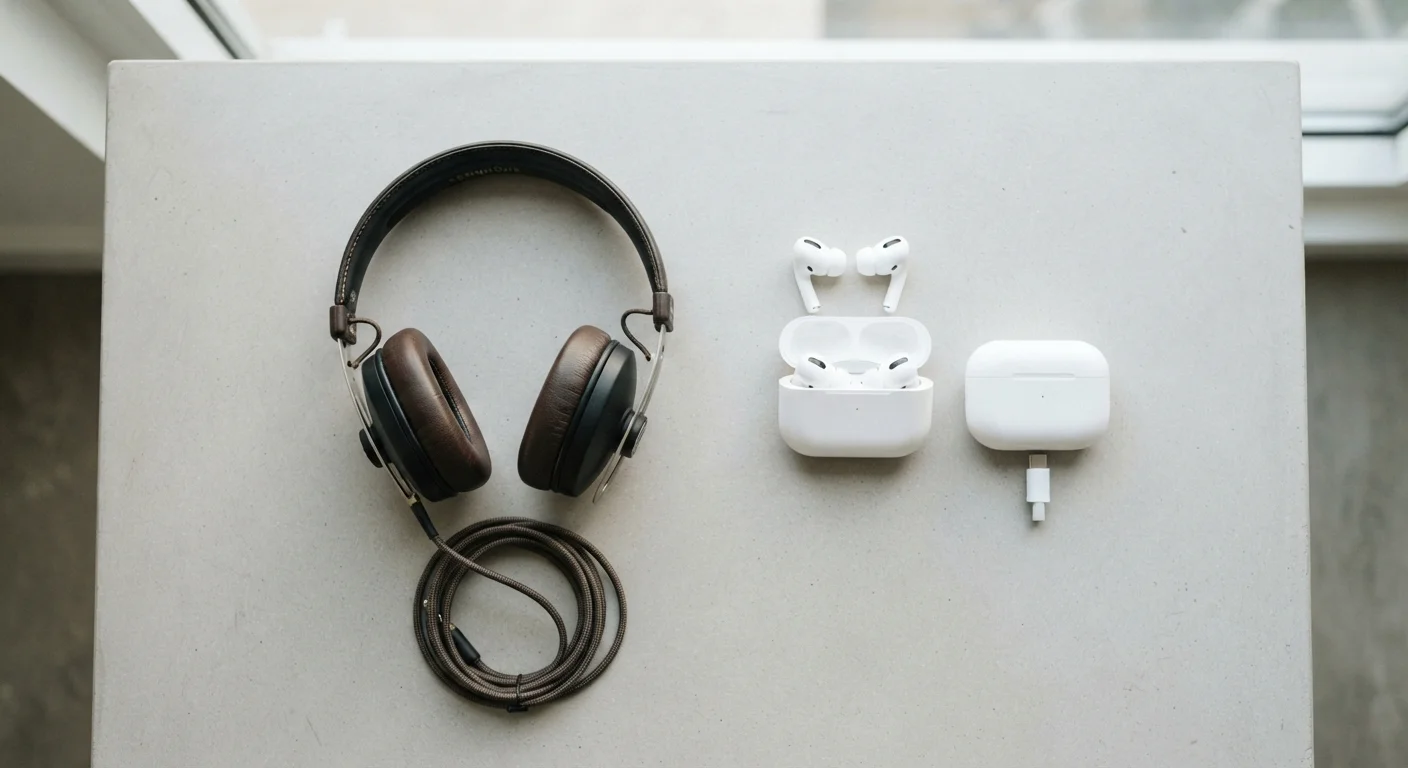
Key Takeaways
- Wired headphones deliver audio without latency and never need charging.
- Wireless earbuds offer true cord-free freedom but depend on battery life.
- Sound quality differences are narrowing, but wired still has a slight edge for detail.
- Wireless earbuds introduce a small audio delay — noticeable mainly during video watching.
- Your lifestyle and daily habits matter more than specs when choosing between the two.
Option A
Wired Headphones
The reliable, no-fuss audio workhorse.
Best for: Anyone who wants consistent sound without worrying about charging or connectivity hiccups.
Option B
Wireless Earbuds
The portable, cable-free listening companion.
Best for: Active users and commuters who prioritize freedom of movement and convenience on the go.
If you work from home and take long video calls
Wired Headphones
Zero latency and no battery anxiety make wired headphones more reliable for extended desk sessions and video conferencing.
If you commute, exercise, or move around throughout the day
Wireless Earbuds
No cable to snag and a compact case make wireless earbuds far more practical for people constantly on the move.
If you primarily watch movies or play games and care about sync
Wired Headphones
Wired connections eliminate the small but perceptible audio delay that wireless earbuds can introduce during video playback.
If you want something low-maintenance and easy to share
Wired Headphones
Plug in and go — no pairing, no charging, no firmware updates needed.
If you frequently take calls while multitasking away from your desk
Wireless Earbuds
Built-in microphones and hands-free operation let you answer calls comfortably while doing other things.
How Each Option Actually Works
Wired headphones connect directly to your device through a physical cable — typically a 3.5mm headphone jack or, increasingly, a USB-C connector. The audio signal travels electrically from your phone, laptop, or tablet straight to the drivers (the small speakers inside the ear cups). No intermediary, no conversion.
Wireless earbuds rely on Bluetooth — a short-range radio technology that transmits audio signals through the air. Your device converts the audio into a wireless signal, the earbuds receive it and convert it back into sound. If you've ever run into Bluetooth hiccups, our guide to Bluetooth pairing explains exactly why that happens and how to fix it.
That extra conversion step in wireless earbuds is what introduces latency — a tiny delay between the audio being sent and you hearing it. For music alone, most people won't notice. For video or gaming, it can feel slightly off.
| Criterion | Wired Headphones | Wireless Earbuds |
|---|---|---|
| Audio Latency | None (direct connection) | Small delay (Bluetooth) |
| Battery Required | No | Yes (5–8 hrs per charge) |
| Portability | Moderate (cable, larger size) | High (compact case) |
| Sound Quality | Slight technical edge | Very good for casual use |
| Ease of Setup | Plug in and play | Bluetooth pairing required |
| Durability | Generally longer lasting | Battery degrades over time |
| Best Environment | Desk, home, studio | Commute, gym, outdoors |
Sound Quality, Battery, and Comfort: The Real Trade-offs
For sound quality, wired headphones have a technical advantage: audio arrives without compression or wireless conversion. Audiophiles often prefer wired for this reason. That said, wireless earbud technology has improved dramatically — for casual listening like podcasts, playlists, and phone calls, most everyday listeners would struggle to notice a meaningful difference.
5–8 hrs
Typical wireless earbud playback per charge
Most mainstream wireless earbuds offer this range, with charging cases adding 20–30 hours of total use.
~100ms
Typical Bluetooth audio latency
Standard Bluetooth audio can introduce around 100 milliseconds of delay; newer codecs like aptX Low Latency can reduce this significantly.
Battery life is the biggest practical concern for wireless users. Most wireless earbuds offer roughly 5–8 hours of playback per charge, with charging cases extending total use to 20–30 hours. Wired headphones have no battery to manage at all — a real advantage for long work sessions or travel days when you'd rather not track power levels.
Comfort varies by design more than by category. Over-ear wired headphones distribute weight across your head, which many people find comfortable for hours. Earbuds sit inside your ear canal, which some find tiring over time. Fit matters — both options come in designs that suit different ear shapes, so what's comfortable for one person may not work for another.
Which Fits Your Everyday Routine?
The honest answer is that neither option is universally better — it comes down to how and where you actually listen.
If your listening happens mostly at a desk — during work, while watching TV, or gaming — wired headphones remove several variables. There's nothing to charge, nothing to pair, and no risk of a call dropping because the earbuds disconnected mid-sentence. They also tend to be more durable over time since there are fewer electronic components that can degrade.
If you're constantly moving — commuting, walking the dog, squeezing in a workout — wireless earbuds are genuinely more practical. No cord means no tangling, no snagging on a jacket zipper, and no pulling your phone out of your pocket accidentally. Many also include features like touch controls and automatic ear-detection that pause audio when you remove them.
Worth noting: some newer smartphones and laptops no longer include a headphone jack, which makes wired headphones slightly less plug-and-play unless you have a compatible adapter. Check your device's ports before assuming wired will be the simpler choice. You might also find our look at smart speakers helpful if you're exploring other ways to listen at home without headphones at all.
Ultimately, both options work well for everyday listeners. The right choice is the one you'll actually use consistently — and that fits where your life takes you.