

Key Takeaways
- A proper pinch grip gives you control and reduces hand fatigue during longer prep sessions.
- The claw hand technique keeps your fingertips safely tucked away from the blade at all times.
- Three cuts — the slice, the rock chop, and the push cut — cover the vast majority of everyday prep work.
- A sharp knife is significantly safer than a dull one because it requires less force.
- Consistent knife skills directly speed up meal prep and improve how evenly food cooks.
Start here
Why Knife Skills Matter
Build your grip
The Pinch Grip: Your Foundation
Stay safe
The Claw Hand and Safe Guiding
Practice techniques
Core Cutting Techniques
Maintain your tool
Keeping Your Knife Ready to Use
Why Knife Skills Matter
Before you can confidently cook a meal from scratch, you need to be comfortable handling a knife. Poor technique doesn't just slow you down — it produces unevenly cut pieces that cook at different rates, leading to food that's simultaneously overdone and underdone in the same pan.
Developing even basic knife skills makes prep work feel less like a chore. Onions, carrots, garlic, herbs — the building blocks of almost every recipe — become faster and more consistent to prepare. If terms like mince, chiffonade, or brunoise sound unfamiliar, our guide to common cooking terms breaks them down in plain language.
You don't need dozens of specialty knives. A single 8-inch chef's knife handles the overwhelming majority of kitchen tasks and is the right tool to learn on.
The Pinch Grip: Your Foundation
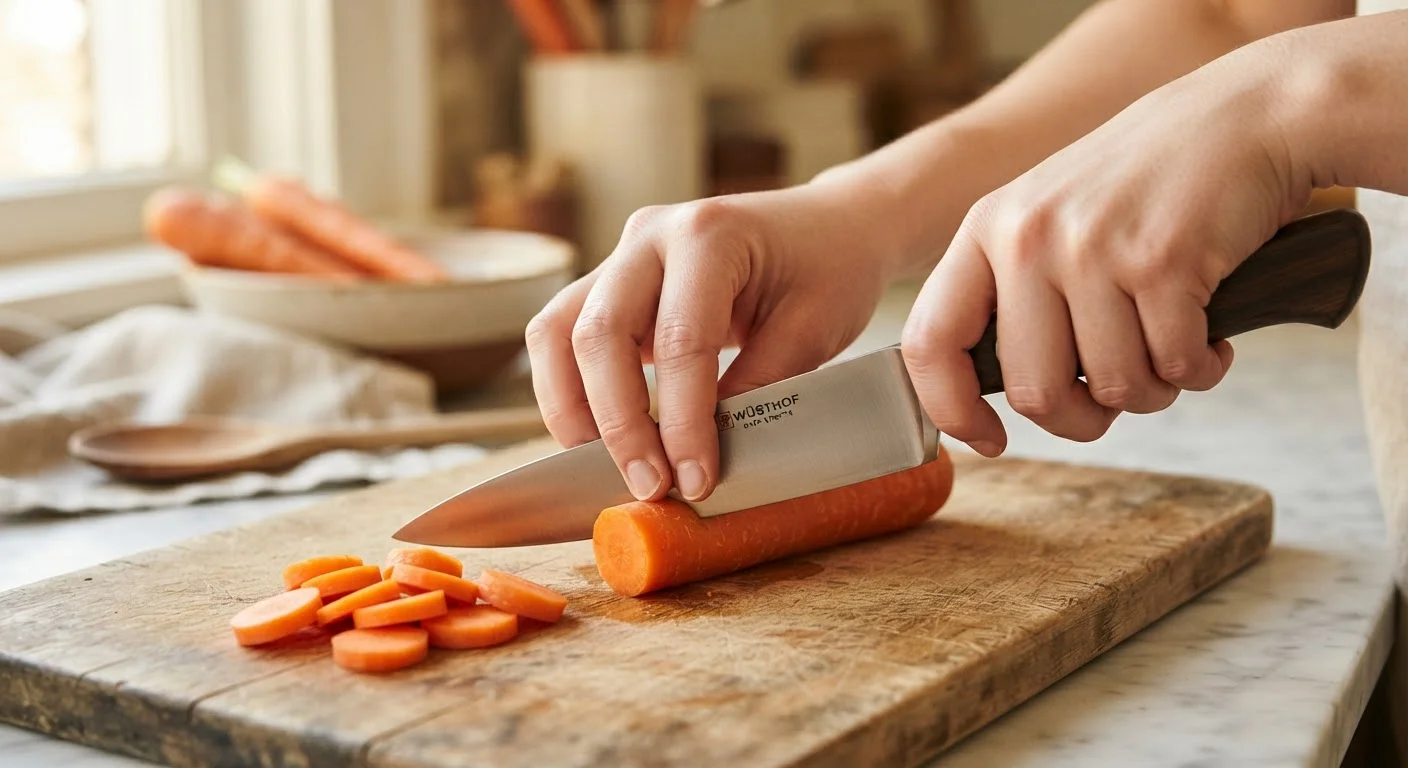
Most beginner cooks hold a knife by the handle alone, which puts the heavy blade far from their control. The pinch grip solves this immediately.
To use it: place your thumb and the side of your bent index finger on the blade itself, just above the bolster (the thick band where blade meets handle). Your remaining three fingers wrap around the handle. This grip centers your control directly over the blade, reduces wrist fatigue, and makes the knife feel far less unwieldy.
Start With Forgiving Ingredients
Practice the pinch grip slowly with a carrot or zucchini before moving to slippery ingredients like onions. Building the habit with easy ingredients means it feels natural by the time conditions get trickier. Even five minutes of deliberate practice per session compounds quickly into lasting muscle memory.
Practice the pinch grip slowly with a carrot or zucchini before moving to slippery ingredients like onions. Building the habit with easy ingredients means it feels natural by the time conditions get trickier.
The Claw Hand and Safe Guiding
Your non-knife hand is just as important as the hand holding the blade. The claw hand technique keeps your fingertips safely out of the knife's path on every single cut.
Curl your fingertips under so your knuckles face outward and lead the cut. The flat side of the blade should rest lightly against your knuckles as you slice — your knuckles become a natural guide and barrier simultaneously. As you progress through the ingredient, the claw hand walks backward in small increments, controlling the thickness of each slice.
Never Let Your Guiding Hand Go Flat
A flat palm puts your fingertips directly in line with the blade. Even experienced cooks remind themselves to maintain the claw before each session — it is always worth reinforcing. If you feel uncertain, slow down; there is no benefit to speed until the technique is automatic.
Never let your guiding hand go flat. A flat palm puts your fingertips directly in line with the blade. Even experienced cooks remind themselves to maintain the claw before each session — it is always worth reinforcing.
Core Cutting Techniques
Three foundational motions cover most of what a home cook needs:
Pinch grip
A knife-holding technique where the thumb and bent index finger pinch the blade just above the handle, giving the cook direct control over the cutting edge.
Claw hand
A guiding hand position where the fingertips curl under and the knuckles face the blade, acting as a natural stop to prevent cuts.
Rock chop
A chopping motion where the blade tip stays on the cutting board while the heel rocks up and down in an arc, useful for herbs and garlic.
Honing
Using a honing rod to realign a blade's existing edge, keeping it sharp between full sharpenings.
Bolster
The thick metal band between the blade and the handle on a chef's knife, providing balance and a natural finger stop.
Julienne
A cut that produces long, thin matchstick strips from vegetables, typically used in stir-fries and salads.
- The slice: Draw the blade backward through the ingredient in one smooth, controlled stroke. Used for proteins, bread, and most vegetables. Avoid pressing straight down — let the blade do the work.
- The rock chop: Keep the tip of the blade in contact with the cutting board while lifting and lowering the heel in a rocking arc. Ideal for herbs, garlic, and soft vegetables that need repeated, rapid chopping.
- The push cut: Drive the blade forward and slightly downward through dense ingredients like root vegetables. The motion is deliberate and firm, not a sawing action.
Once you're comfortable with these, building a well-stocked kitchen around your new skills becomes much more rewarding. Our guide to keeping your kitchen organised for faster cooking covers how to set up your prep space so these techniques feel natural and efficient every time.
Keeping Your Knife Ready to Use
A sharp knife is a safe knife. Dull blades require more force per cut, which dramatically increases the chance of slipping. Two simple maintenance habits make a measurable difference:
- Hone regularly: A honing rod (also called a sharpening steel) realigns the blade's microscopic edge. A few passes before a cooking session keeps your knife performing consistently between sharpenings.
- Sharpen a few times a year: Depending on how frequently you cook, a whetstone or a pull-through sharpener removes small amounts of metal to restore a dull edge. If you're unsure about technique, many kitchen supply stores offer sharpening services.
Store knives on a magnetic strip or in a knife block to protect the edges — loose in a drawer, they dull quickly and pose a grab hazard. A well-maintained knife paired with the grip and technique you've learned here is all you need to approach the next step: our guide to eggs as a cooking fundamental puts these skills to immediate use on one of the most versatile ingredients in the kitchen.