

Key Takeaways
- Vertical wall space is one of the most underused storage opportunities in small homes.
- Furniture that doubles as storage can dramatically reduce clutter without adding footprint.
- Consistent decluttering matters as much as adding new storage — both work together.
- Most effective solutions require no drilling, permanent fixtures, or structural changes.
- Small organisational habits compound over time into noticeably more functional spaces.
Why Small-Space Storage Feels So Hard
Living in a compact apartment or a room that pulls double duty — bedroom and office, kitchen and dining area — means every square foot is working overtime. The instinct is often to think renovation: built-in shelving, custom cabinetry, a contractor on speed dial. But the reality is that most storage problems are solved long before you reach that point.
The key shift is moving from adding space to using existing space better. That means looking up, looking under, and reconsidering every surface and piece of furniture you already have. If your kitchen organisation could also use attention, the same logic applies — see our guide to keeping a home kitchen organised for parallel ideas.
The eight strategies below are all renter-friendly, budget-conscious, and require no permanent modifications. They work in studios, shared homes, and any room where space feels tight.
Go Vertical With Freestanding Shelving
Floor-to-ceiling freestanding shelving units take up minimal floor space while dramatically increasing usable storage volume. Unlike wall-mounted options, they require no drilling and can move with you. Look for adjustable-shelf models so you can reconfigure as your needs change — taller gaps for bulky items, shorter gaps for books or folded linens.
Anchor tall units to the wall with furniture safety straps for stability, especially in households with children. These straps are removable and leave no lasting damage to walls.
Freestanding shelves add vertical storage without a single drill hole.
Use the Space Under Your Bed
The average bed frame sits 7–13 inches off the floor — enough clearance for flat storage bins. This space is ideal for seasonal clothing, extra bedding, or shoes you don't reach for daily. Flat rolling bins with lids keep items dust-free and accessible. If your bed sits lower, bed risers can add several inches of clearance affordably.
Label bins clearly so you're not pulling everything out to find what you need. A simple label maker or even masking tape with a marker works fine.
Under-bed space is often the most overlooked storage zone in a bedroom.
Hang an Over-the-Door Organiser
The back of a door is a surprisingly large, entirely unused surface in most homes. Over-the-door organisers — in fabric, wire, or clear pocket styles — attach with hooks that rest on the door frame, leaving no marks. They work in bathrooms for toiletries, in bedrooms for accessories, inside pantry doors for spices and snacks, or in home offices for stationery.
Choose an organiser sized to your door so it clears the frame cleanly when the door swings shut.
Door backs are blank storage real estate hiding in plain sight.
Choose Furniture That Does Double Duty
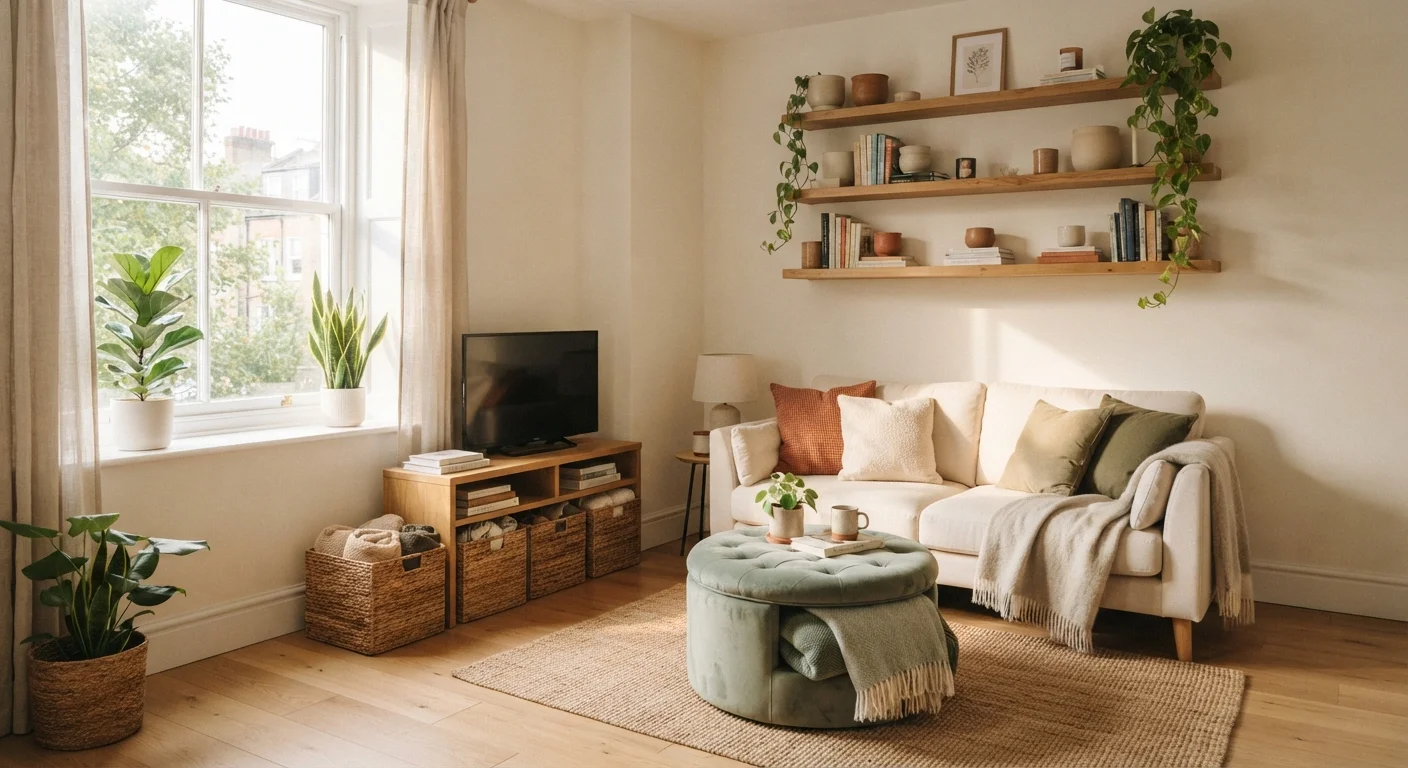
Storage ottomans, lift-top coffee tables, bed frames with built-in drawers, and benches with interior compartments all serve their primary function while adding hidden capacity. In a small living room, a storage ottoman can replace a traditional coffee table and hold blankets, board games, or electronics accessories inside.
When selecting new furniture for a compact space, storage potential is worth treating as a core feature rather than a bonus.
Every piece of furniture in a small home should ideally earn its footprint twice over.
Declutter Before Organising — Not After
The most common storage mistake is trying to organise too much stuff. Before adding bins, baskets, or shelves, spend time reducing what you actually keep. A simple rule: if you haven't used something in twelve months and it has no sentimental value, it's a candidate for donation or disposal.
Decluttering first means your new storage solutions accommodate what you genuinely need rather than just shuffling clutter into neater containers.
Organising clutter without decluttering first just makes the clutter harder to find.
Use Stackable, Standardised Containers
Mismatched containers waste space through irregular shapes and wasted air gaps. Choosing stackable bins in one or two standard sizes — across your closets, bathroom, and kitchen — allows you to build vertical stacks that use the full height of shelves and cupboards. Clear containers help at a glance; opaque ones with labels work just as well.
Standardised containers also make it easier to reconfigure storage when your needs shift, without starting from scratch.
Uniform containers stack higher and waste far less shelf space than mismatched ones.
Install Tension-Rod Dividers Inside Cabinets
Tension rods — the same kind used for curtains — can be installed vertically inside deep kitchen or bathroom cabinets to create dividers for baking sheets, cutting boards, pan lids, or flat items that would otherwise be stacked in unstable piles. They require no tools and are removed in seconds.
Horizontal tension rods inside cabinet doors can also hold spray bottles by their trigger handles, freeing up the shelf below for other items.
Tension rods are one of the most versatile, no-damage cabinet organisers available.
Create a Dedicated Drop Zone Near the Entry
Clutter near entryways is one of the fastest ways for a small home to feel chaotic. A simple hook rail, a small shelf, and a bin or basket near the front door gives keys, bags, shoes, and daily-use items a consistent home. This reduces the spread of clutter into the rest of the space and makes leaving the house faster.
Even in the smallest entryways, a wall-mounted hook rail and a single basket on the floor can handle the bulk of what would otherwise end up on counters and chairs.
A defined entry zone stops daily clutter from spreading through the rest of the home.
Putting It All Together
Storage solutions compound. One freestanding shelf unit is helpful; pair it with under-bed bins, a door organiser, and a decluttered closet, and the same square footage suddenly feels generous. The goal isn't perfection — it's removing friction from daily life so your home feels calm rather than chaotic.
Start With One Zone, Not the Whole Home
Trying to reorganise everything at once is overwhelming and often leads to abandoning the effort entirely. Pick one room, one closet, or even one shelf and complete it fully before moving on. The sense of progress from one finished zone tends to build momentum for the rest of the home.
If you share your space with others, it helps to align on storage habits together. Our article on making a shared home feel comfortable for everyone covers practical ways to balance different needs under one roof. And if opening up the space visually is also on your list, small-scale changes like rug size and mirror placement can do more than you'd expect — explore natural light and the small changes that make rooms feel bigger for low-effort ideas.