

Key Takeaways
- Food processing exists on a spectrum — not all processed foods are equally harmful.
- Ultra-processed foods often contain additives that alter flavor, texture, and shelf life beyond basic preservation.
- Research links high ultra-processed food consumption to increased risks of chronic disease.
- Whole foods provide nutrients in forms the body recognizes and uses efficiently.
- Small, realistic shifts toward less-processed options can meaningfully improve dietary quality.
Our Verdict
Whole foods offer a denser nutritional profile and fewer additives, making them the stronger foundation for long-term health. That said, not every packaged or processed food is a threat — the key is understanding where on the spectrum your everyday choices land, and nudging them gradually toward less processed options where it counts most.
| Best for | Recommended |
|---|---|
| Those prioritizing long-term health and nutrient density | Whole and minimally processed foods |
| Those balancing convenience with reasonable nutritional quality | Processed culinary ingredients and basic packaged staples |
| Those exploring label literacy and smarter supermarket choices | Learning to read nutrition panels and ingredient lists |
What Do We Mean by 'Processed'?
The word processed gets thrown around a lot, but it covers an enormous range of foods — from a bag of frozen spinach to a neon-colored cheese-flavored snack. To make sense of it, nutrition researchers developed a classification system called NOVA, which groups foods by the nature and extent of the processing applied to them.
NOVA identifies four groups:
- Whole and unprocessed foods — fresh fruits, vegetables, eggs, plain meat, and legumes.
- Processed culinary ingredients — oils, flours, sugar, and salt; typically used to prepare meals rather than eaten alone.
- Processed foods — products like canned beans, smoked fish, or aged cheese, where processing is mainly for preservation or flavor.
- Ultra-processed foods (UPFs) — industrially formulated products containing additives rarely found in home kitchens: emulsifiers, artificial flavors, color stabilizers, and more.
Understanding this framework helps you see food quality as a spectrum rather than a simple good-or-bad binary. For a deeper dive into decoding what's on your packaging, see our guide to reading nutrition labels.
Whole Foods vs. Ultra-Processed Foods: How They Compare
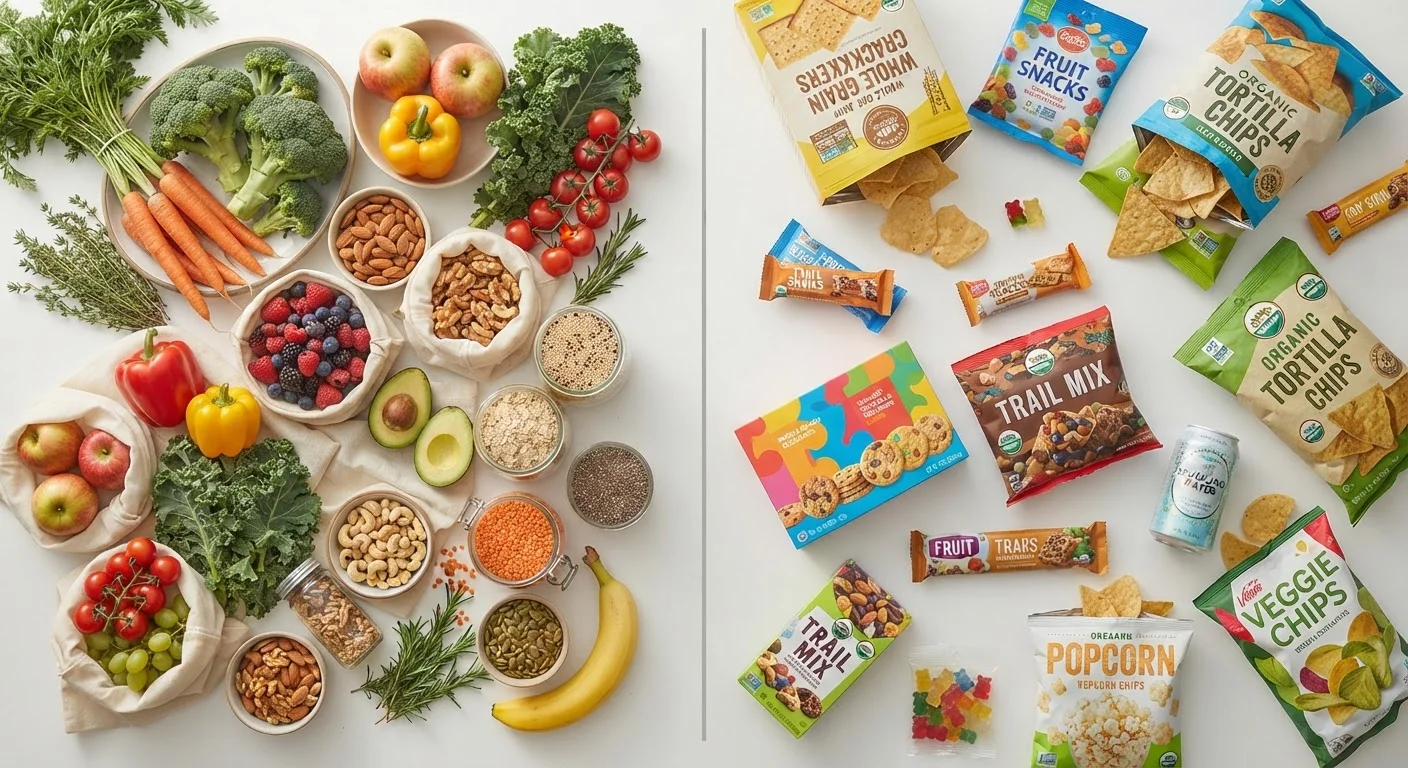
The nutritional gap between whole foods and ultra-processed foods is significant — but understanding why helps you make smarter choices rather than just following rules.
| Whole Foods | Minimally Processed | Ultra-Processed Foods | |
|---|---|---|---|
| Ingredient complexity | Single ingredient | Few recognizable ingredients | Long list with additives |
| Nutrient density | High — vitamins, minerals, fiber | Moderate, largely retained | Often low relative to calories |
| Added sugar/sodium | None naturally added | Minimal, for preservation | Frequently high |
| Satiety effect | Strong — fiber and water content | Moderate | Often weak despite high calories |
| Shelf stability | Short — perishable | Extended by simple methods | Very long — preservatives used |
| Convenience | Requires prep | Moderate prep needed | Ready to eat immediately |
Ultra-processed foods are engineered to be highly palatable — high in salt, sugar, and fat simultaneously — which can make it harder to tune in to natural hunger and fullness cues. Emerging research also suggests that the matrix of food (how nutrients are physically structured) matters, not just the nutrient totals. A whole apple delivers fiber, water, and sugar in a physical structure that slows absorption; apple-flavored candy delivers sugar without that structure.
It's also worth noting that some fortified processed foods add back nutrients stripped during manufacturing. For context on how that stacks up nutritionally, our article on fortified foods vs. natural food sources walks through the science.
The 5-Ingredient Shortcut
When scanning packaged foods, try a quick rule of thumb: if the ingredient list has five or fewer items you could find in your own kitchen, it's likely on the less-processed end of the spectrum. This isn't a hard scientific rule, but it's a fast, practical starting point that gets easier with practice. Pair it with checking the sodium and added-sugar lines on the nutrition panel for the full picture.
What the Research Actually Says
A growing body of epidemiological research — including large cohort studies from France, the UK, and the US — has associated higher ultra-processed food consumption with elevated risks of cardiovascular disease, type 2 diabetes, obesity, and even certain cancers. These are observational findings, meaning they show correlation rather than definitive cause-and-effect, and researchers continue to debate which mechanisms are most responsible.
57%
Share of US calories from ultra-processed foods
Research published in the BMJ estimated that ultra-processed foods account for over half of daily caloric intake for the average American adult.
32%
Higher obesity risk association
A large prospective cohort study found participants in the highest ultra-processed food consumption quartile had meaningfully higher rates of overweight and obesity.
10%
Increased cardiovascular disease risk per serving increment
A study in the European Heart Journal found each additional daily serving of ultra-processed food was associated with a roughly 12% higher risk of cardiovascular events, though causality is not confirmed.
What makes ultra-processed foods a target isn't any single ingredient but the combination of industrial additives, high energy density, low satiety, and the displacement of whole foods in the diet. When UPFs make up a large share of daily calories, it becomes harder to meet fiber, micronutrient, and phytonutrient needs naturally.
Understanding how marketing language can muddy these waters is equally important. Phrases like "natural" or "low fat" don't automatically signal a less-processed product. Our article on what nutrition claims on packaging really mean explains what those front-of-pack terms are — and aren't — permitted to guarantee.
Practical Ways to Shift the Balance
The goal isn't perfection. It's awareness — and gradual, sustainable adjustment. Here are some grounded strategies:
- Use the ingredient list as your guide. A shorter list of recognizable ingredients generally signals less processing. Additives like carrageenan, high-fructose corn syrup, or partially hydrogenated oils are common UPF markers.
- Anchor meals in whole foods. Build your plate around vegetables, legumes, whole grains, and lean proteins. Processed elements become occasional additions rather than foundations.
- Understand your own patterns. Our article on why grocery shopping drifts toward ultra-processed food explores the environmental and psychological factors that steer these choices — worth reading before your next shop.
- Make comparisons within categories. Swapping an ultra-processed breakfast bar for plain oats with fruit is a meaningful upgrade. You don't have to overhaul everything at once.
Also keep in mind that not all fats and macronutrients behave the same way — the type of fat in a processed food matters. Our breakdown of saturated, unsaturated, and trans fats can help you read labels with more confidence.
This article is for general informational and educational purposes only and is not a substitute for personalized medical or dietary advice. Please consult a qualified healthcare professional or registered dietitian for guidance specific to your health needs.