

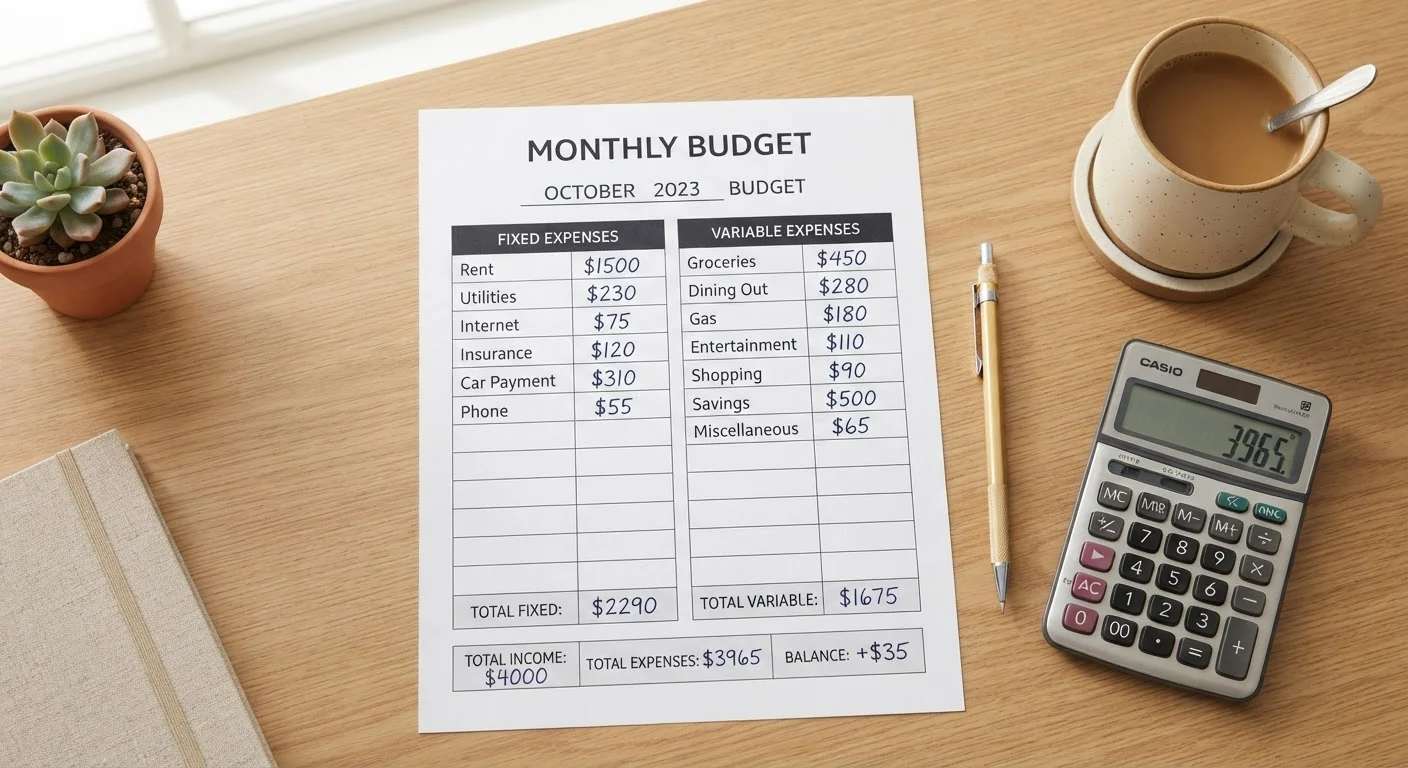
Key Takeaways
- Fixed expenses stay the same each month; variable expenses change based on behavior or usage.
- Most households have more variable expenses than they realize, which is where budget flexibility lives.
- Knowing both categories helps you set realistic spending limits instead of guessing.
- Variable expenses are usually the first place to look when you need to cut spending quickly.
- Some expenses — like utilities — are semi-fixed and belong in their own planning category.
Option A
Fixed Expenses
The predictable, consistent foundation of your monthly spending.
Best for: Anchoring your budget with costs you can count on being the same each month.
Option B
Variable Expenses
The flexible, fluctuating costs that require active management.
Best for: Identifying where you have real room to adjust spending when money is tight.
If you want to build a simple, reliable monthly budget from scratch
Fixed Expenses
Start by listing your fixed expenses first — they give you an immediate, dependable baseline for how much income is already spoken for each month.
If you're trying to find room to save or pay off debt
Variable Expenses
Variable expenses are where meaningful reductions are actually possible. Targeting dining, subscriptions, and discretionary spending can free up cash quickly.
If your budget keeps falling apart mid-month
Variable Expenses
Unplanned variable costs are usually the culprit. Tracking them closely — even for just one month — reveals the patterns that silently drain your account.
What Are Fixed Expenses?
A fixed expense is any cost that stays the same amount every billing cycle, regardless of how much you use a service or how your life changes month to month. You owe that amount, it's due on a predictable date, and there's very little you can do to change it in the short term.
Common examples include:
- Rent or mortgage payment
- Car loan or lease payment
- Student loan payment (on a standard repayment plan)
- Insurance premiums (health, auto, renters, life)
- Certain subscription services billed at a flat rate
Fixed expenses are useful anchors for your budget. Once you list them all, you know immediately how much of your monthly income is already committed before you spend a single discretionary dollar. For most households, fixed expenses represent the non-negotiable floor of their spending. If you want a deeper grounding in budgeting vocabulary, the Key Terms Every Beginner Budgeter Should Know is a helpful place to start.
What Are Variable Expenses?
A variable expense is any cost that fluctuates from month to month — either because of how much you use something or because of choices you make. These are the line items that budget planners often underestimate, because they don't show up as a single, predictable number.
Common examples include:
- Groceries
- Gas or rideshare costs
- Dining out and entertainment
- Clothing and personal care
- Electricity and water bills (usage-based)
- Medical co-pays or out-of-pocket expenses
Variable expenses are where your budget either succeeds or quietly unravels. They're also where you have the most agency. When income drops or an unexpected bill arrives, variable expenses are typically the first place to look for cuts. If you've ever wondered why your budget keeps falling apart mid-month, untracked variable spending is usually a major factor.
| Criterion | Fixed Expenses | Variable Expenses |
|---|---|---|
| Amount each month | Stays the same | Changes based on usage or choices |
| Predictability | High — easy to plan around | Low to moderate — requires tracking |
| Examples | Rent, car payment, insurance | Groceries, gas, dining, utilities |
| Short-term flexibility | Very limited | High — adjustable month to month |
| Where to look for cuts | Requires renegotiation or life change | Immediate reductions are possible |
| Budgeting approach | List once; update rarely | Track monthly; set category limits |
Semi-Variable Expenses: The In-Between Category
Not every expense fits neatly into fixed or variable. Semi-variable expenses — sometimes called semi-fixed — have a predictable base cost but can increase depending on your usage. Utilities are the classic example: your internet bill might be flat, but your electric bill rises in summer when the air conditioning runs constantly.
What About Semi-Variable Expenses?
Expenses like electricity, water, and even groceries can behave as both fixed and variable depending on season and household habits. These are sometimes called 'semi-variable' or 'semi-fixed' costs. When building your budget, it helps to assign these their own category rather than forcing them into one column or the other — it makes your plan more realistic and less prone to surprise shortfalls.
When budgeting for semi-variable costs, a practical approach is to use your highest recent month as your planning number. That way, you're never caught short, and any months where spending comes in lower feel like a win — extra cushion you can redirect toward savings or debt payoff.
How to Use Both Categories to Build a Better Budget
The most reliable budgeting method starts with separating your expenses into these two buckets before you allocate anything. Here's a straightforward approach:
- List all fixed expenses first. Total them up. This is your committed baseline — income minus fixed costs tells you what's actually available to work with.
- Estimate variable expenses by category. Use past bank or card statements to get realistic averages. Guessing leads to gaps. Tracking leads to clarity.
- Flag semi-variable expenses separately. Budget for them at the high end of their recent range.
- Compare your totals to your take-home income. If expenses exceed income, variable costs are where you can make meaningful adjustments.
Whether you're new to budgeting or rebuilding after a rough stretch, understanding these two categories is the foundation everything else rests on. You can also apply this framework beyond household finances — it's equally valuable when building a realistic travel budget before booking anything.
~33%
Average share of income spent on housing alone
The U.S. Bureau of Labor Statistics Consumer Expenditure Survey consistently shows housing as the largest single fixed expense for American households.
$1,000+
Estimated monthly variable spending for average U.S. household
Food, transportation, and entertainment combined represent a substantial and highly adjustable portion of most household budgets, according to BLS consumer expenditure data.
If you're deciding how detailed your tracking needs to be, our comparison of a spending tracker vs. a full budget can help you find the right level of structure for your situation. And if your income varies from month to month, the same fixed-vs-variable framework applies — with some important adjustments covered in our guide to budgeting on an irregular income.
This article is for general informational and educational purposes only and does not constitute personalized financial advice. Consider consulting a qualified financial professional for guidance specific to your situation.