

Key Takeaways
- Minimum payments are calculated to keep balances high and interest charges flowing for as long as possible.
- On a $3,000 balance at 20% APR, paying only the minimum can take over a decade to pay off.
- The total interest paid on minimum-only payments often exceeds the original purchase price.
- Paying even a small amount above the minimum each month dramatically shortens your payoff timeline.
- Card issuers are required to show your payoff timeline on statements — use that information.
The Math Behind Minimum Payments
Credit card minimum payments are typically calculated as a small percentage of your outstanding balance — often around 1–2% of what you owe, or a flat dollar amount (like $25), whichever is higher. That sounds manageable, and that's precisely the point.
Here's what that actually looks like: Say you carry a $3,000 balance on a card with a 20% annual percentage rate (APR). If your minimum payment is roughly 2% of your balance, you'd start by paying about $60 a month. The problem is that most of that payment goes straight to interest, not the principal — the actual amount you borrowed.
10+ years
Typical payoff timeline on minimum payments
The Consumer Financial Protection Bureau (CFPB) notes that minimum-only payments on a moderate balance at typical credit card interest rates can extend repayment well beyond a decade.
~20%
Average U.S. credit card APR
According to Federal Reserve data, average credit card interest rates have remained near or above 20% in recent years, making revolving balances especially costly.
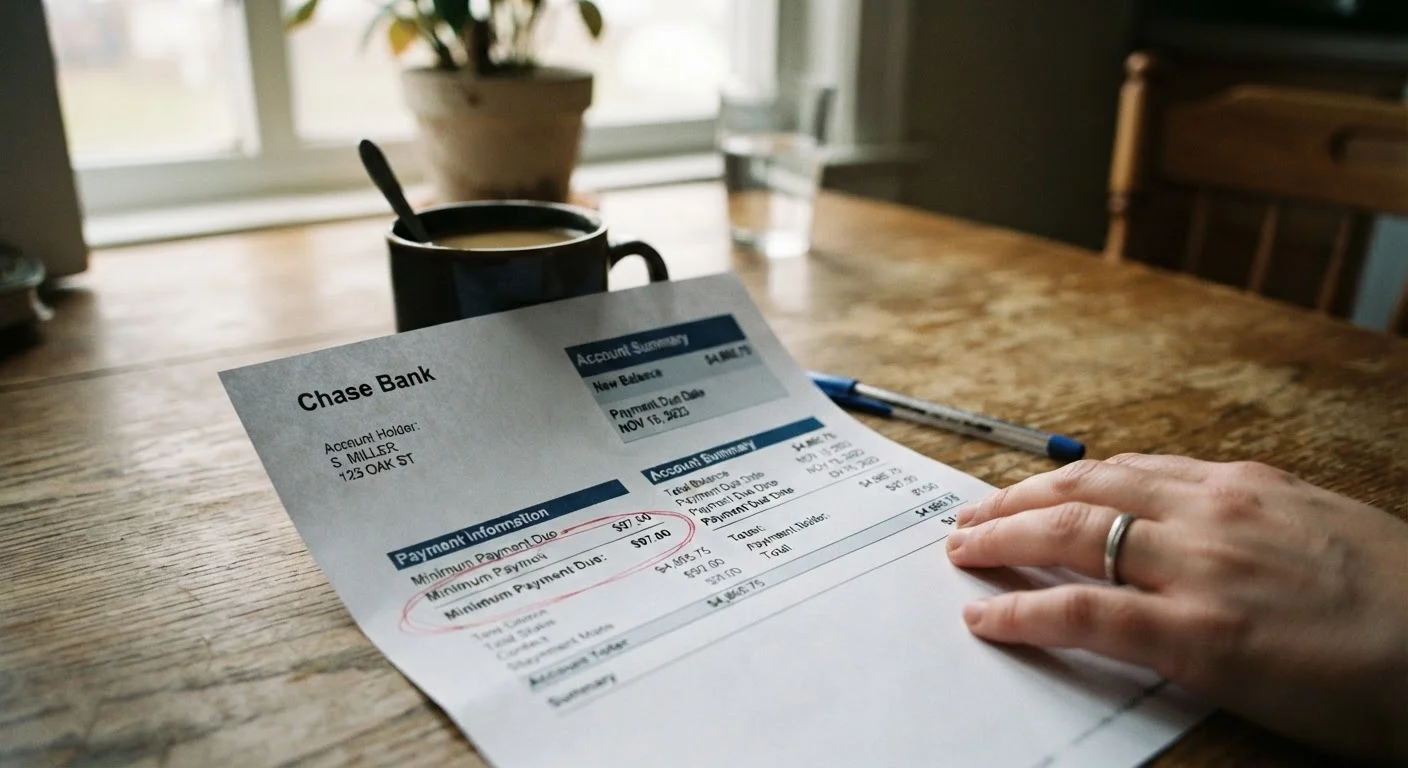
Because the minimum shrinks as your balance slowly drops, you end up making smaller and smaller payments over time, dragging the debt out for years. Federal law requires credit card statements to include a minimum payment warning showing exactly how long it will take to pay off your balance if you only make the minimum. Check yours — the number is often startling.
Mistakes That Keep You Stuck
Treating the minimum payment as the "normal" payment amount.
Why it happens: Card issuers prominently display the minimum due, and many people assume that paying it means they're managing debt responsibly.
Ignoring how interest compounds against you each billing cycle.
Why it happens: Interest charges are abstract — they don't feel as real as a purchase. Many people don't realize that unpaid interest gets added to the principal, which then also accrues interest.
Continuing to charge new purchases while only paying the minimum on an existing balance.
Why it happens: It feels like progress to make a payment, even a small one, while life continues. But adding new charges while barely covering interest means the balance never meaningfully declines.
Assuming a lower interest rate doesn't matter much.
Why it happens: The difference between 18% and 24% APR sounds small, but on a revolving balance it's significant. Many people don't shop around or inquire about rate reductions.
Understanding these patterns is the first step toward breaking them. If your budget is also working against you, it may be worth reading about why budgets fall apart mid-month — the two problems often feed each other.
How to Actually Get Ahead of the Debt
Paying more than the minimum doesn't have to mean a dramatic lifestyle overhaul. Even an extra $20–$50 per month above the minimum can shave months or years off your payoff timeline and save a meaningful amount in interest.
Two structured approaches worth understanding: the debt avalanche (targeting the highest-interest debt first to minimize total interest paid) and the debt snowball (paying off the smallest balance first for psychological momentum). Both are more effective than minimum-only payments. You can explore both in detail in our comparison of the debt avalanche and snowball methods.
Don't Confuse Activity With Progress
Making a payment every month can feel like you're on top of your debt — but if that payment barely covers the interest charge, your balance is barely moving. Check your statement's "minimum payment warning" box to see your actual payoff date. If it's more than two or three years out, that's a signal to increase what you're paying.
If you're uncertain whether to direct extra cash toward debt or savings first, that trade-off has real nuance — see saving vs. paying off debt: which should come first for a clear breakdown.
This article is for general informational purposes only and does not constitute personalized financial advice. Consult a qualified financial professional for guidance specific to your situation.