

Key Takeaways
- Carry-on bags keep medications, documents, and valuables under your direct control at all times.
- Checked bags allow more packing freedom but introduce real risk of delay, loss, or damage.
- Airlines lose or mishandle millions of bags annually — understanding this risk helps you pack smarter.
- Splitting essentials between both bag types is a practical strategy for longer trips.
- Your luggage decision has direct implications for how quickly you can respond to travel disruptions.
Option A
Carry-On Luggage
The agile, always-with-you travel option.
Best for: Travelers prioritizing speed, security, and immediate access to their essentials.
Option B
Checked Luggage
The spacious, versatile option for longer or more complex trips.
Best for: Travelers needing more gear, specialty equipment, or packing for extended stays.
If you rely on daily medications or medical devices
Carry-On Luggage
Medications and medical equipment should always stay within your reach. A checked bag can be delayed for days, leaving you without critical supplies.
If you're traveling for two or more weeks
Checked Luggage
Extended trips often require clothing variety, specialty gear, or gifts. A checked bag provides the space carry-on limits simply can't match.
If your trip involves multiple connecting flights
Carry-On Luggage
Each connection is an opportunity for checked bags to be misrouted. Keeping everything with you eliminates that compounding risk.
If you're traveling with sports equipment or bulky gear
Checked Luggage
Skis, scuba equipment, and similar gear cannot fit in overhead bins. Airlines have specific policies for oversized items checked at the gate or counter.
If fast airport movement is a priority
Carry-On Luggage
Skipping baggage claim can save 30–60 minutes per trip leg, a significant advantage during tight layovers or time-sensitive arrivals.
What's Really at Stake With Your Luggage Choice
Most travelers think about luggage in terms of fees and convenience. But the decision between carry-on and checked baggage has real consequences for your safety, health management, and ability to handle disruptions on the road.
When your bag is in the overhead bin, you control it. When it's in the cargo hold, you don't — and anything can happen between check-in and baggage claim. That gap matters most when the contents include irreplaceable items: prescription medication, travel documents, medical devices, or valuables.
Before your next trip, reviewing a pre-trip safety checklist can help you think through exactly what needs to stay close and what can safely go below deck.
| Criterion | Carry-On Luggage | Checked Luggage |
|---|---|---|
| Access during travel | Immediate, always with you | Inaccessible until baggage claim |
| Risk of loss or delay | Very low | Real — millions mishandled annually |
| Packing capacity | Limited by airline size rules | Significantly more space |
| Liquid and item restrictions | Strict TSA 3-1-1 liquid rules apply | More flexible for liquids and tools |
| Checked bag fees | None (usually) | $30–$75+ per leg on many US carriers |
| Suitable for medications | Yes — strongly recommended | Not advisable for critical medications |
| Airport speed | Faster — skip baggage claim | Slower — wait at carousel |
| Best trip length | Short trips, 1–5 days | Week-long or extended travel |
The Safety Case for Carry-On Travel
Carrying your bag onto the plane is the most reliable way to ensure your essentials arrive when you do. For travelers managing health conditions, this isn't a matter of preference — it's a practical necessity.
Medications, insulin that requires temperature stability, CPAP machines, and similar items should never be packed in checked bags. Beyond personal health needs, your passport, travel insurance documentation, and emergency cash are all items that become inaccessible — or worse, lost — when placed in checked luggage.
There's also a disruption-readiness argument. If your flight is diverted, delayed overnight, or if you need to rebook quickly, having your essentials in hand gives you immediate options. Travelers waiting on a missing checked bag have far fewer of them. Our guide on handling travel disruptions walks through exactly this kind of scenario.
~2.9M
Bags mishandled by US airlines in one year
According to the US Department of Transportation's Air Travel Consumer Report, nearly 3 million bags were reported lost, damaged, or delayed in a recent annual period.
30–60 min
Time saved by skipping baggage claim
Travel logistics experts generally estimate that bypassing baggage claim saves approximately 30 to 60 minutes per flight leg, depending on the airport.
3.4 oz
TSA carry-on liquid container limit
The TSA's 3-1-1 rule restricts liquids in carry-on bags to containers of 3.4 ounces or less, all fitting in one quart-sized clear bag per traveler.
When Checked Luggage Makes Sense
Carry-on travel has its limits. Overhead bin space is restricted, size rules vary by airline, and some items — aerosols over 3.4 oz, certain tools, or liquids in larger quantities — are simply not permitted in the cabin.
For trips longer than a week, or journeys requiring formal attire, outdoor gear, or gifts, a checked bag often becomes unavoidable. The key is managing checked-bag risk intelligently rather than avoiding it entirely.
Practical strategies include: placing a copy of your itinerary inside the bag (in case the tag is lost), using a luggage tracker, avoiding packing anything irreplaceable, and keeping your medications and documents in your carry-on regardless of what else goes below. Consider the trade-offs a natural extension of broader trip logistics — the same mindset covered in pre-departure planning.
Documents, Valuables, and the Split-Bag Strategy
One practical approach for longer trips is the split-bag strategy: check a bag for clothing and non-essentials, while keeping a carry-on or personal item stocked with everything that truly matters. Think of the checked bag as expandable storage and the carry-on as your emergency kit.
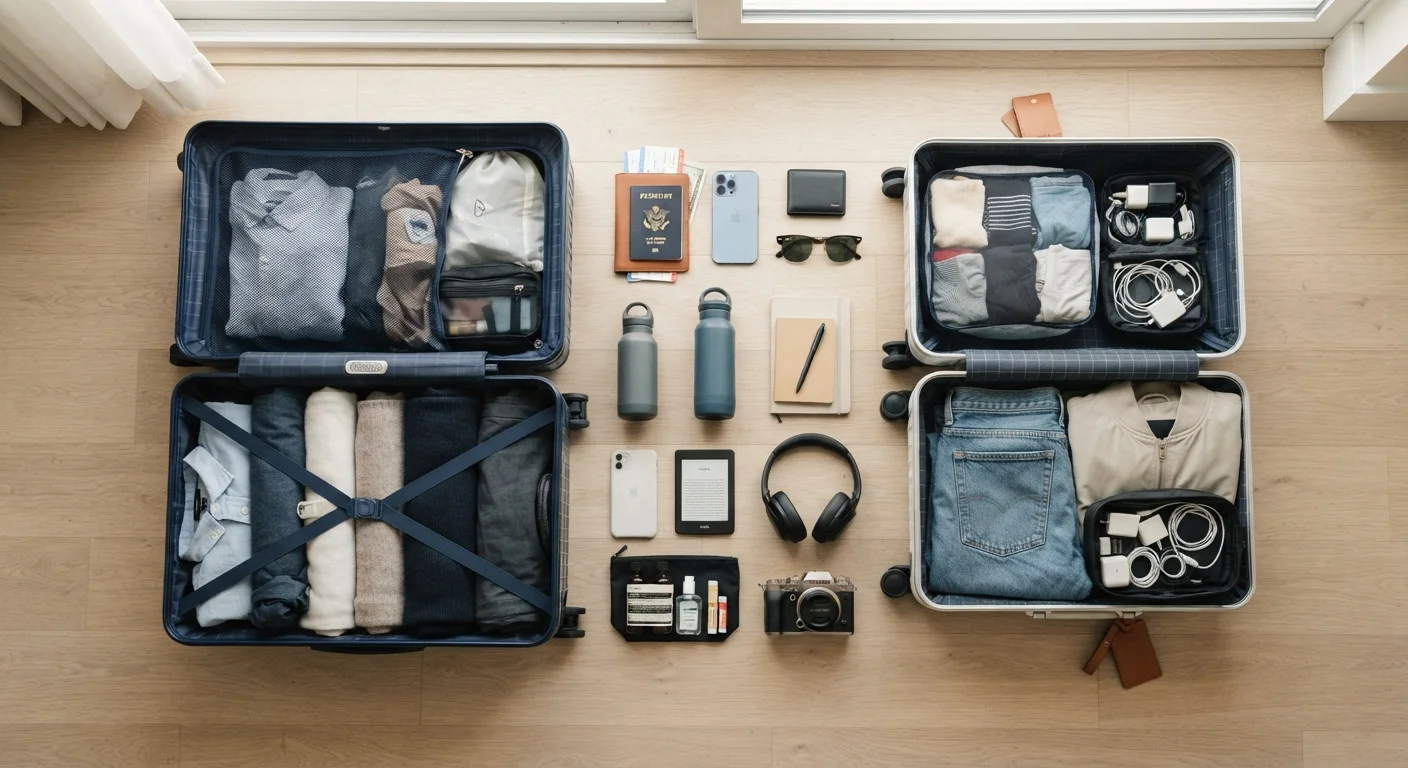
Your carry-on should always contain: all medications (with prescriptions), travel documents, one day's change of clothes, phone chargers and electronics, and any cash or cards you'd need immediately. This mirrors guidance around carrying document backups — physical and digital redundancy protects you when things go sideways.
TSA Rules for Medications and Medical Devices
The TSA allows medications in carry-on bags and does not require them to be in their original containers, though it recommends it. Medically necessary liquids — including larger quantities of medication — are exempt from the standard 3.4 oz rule but must be declared at the checkpoint. If you travel with a medical device such as a CPAP machine or insulin pump, inform TSA officers before screening. Always verify current TSA guidelines at tsa.gov before your trip, as rules can be updated.
Budget travelers may also factor in that carry-on-only travel eliminates checked bag fees, which can range from $30 to $75 or more per leg on US domestic carriers. For a round-trip with two travelers, that's a meaningful cost. See how luggage decisions intersect with broader budget dynamics in our travel on a budget resource hub.