

Key Takeaways
- Most cleaning schedules fail because they're built around an ideal household, not a real one.
- Splitting tasks into daily, weekly, and monthly categories keeps the load manageable.
- Assigning tasks to existing habits — like coffee or bedtime — makes them far more likely to stick.
- A schedule you follow 70% of the time beats a perfect one you abandon after two weeks.
- Deep cleaning and regular maintenance serve different purposes and belong on separate timelines.
What you will need
Why Most Cleaning Schedules Don't Stick
The typical cleaning schedule fails for one reason: it's built around an imaginary household. It assumes you have two free hours on Saturday, no chaotic weeks, and the motivation of someone who just moved into a spotless apartment. Real life doesn't work that way.
The fix isn't more discipline — it's a more honest design. When tasks are matched to your actual home, your actual schedule, and your actual energy levels, following through becomes the path of least resistance rather than a constant uphill effort.
It's also worth separating two related but distinct problems. Why your home feels cluttered even after cleaning explains why tidying and cleaning are different challenges — and why solving one doesn't automatically solve the other. If clutter is part of your struggle, a room-by-room decluttering approach can run alongside your cleaning schedule without requiring a full weekend overhaul.
What you will need
Building the Schedule Step by Step
The steps below walk you through designing a cleaning schedule from scratch — starting with what your home actually needs, not what a generic template assumes.
Notepad or digital notes app
Used to draft and store your cleaning task list before building the schedule.
Weekly planner or wall calendar
Helps assign cleaning tasks to specific days so nothing is left to chance.
Timer (phone or kitchen timer)
Keeps individual cleaning sessions short and focused, reducing resistance to starting.
Audit what actually needs cleaning in your home
Walk through every room and write down every cleaning task you can identify — floors, surfaces, toilets, mirrors, laundry, dishes, trash. Don't filter yet. The goal is a complete, honest list of what your specific home requires, not a generic template from a magazine.
Note which tasks feel urgent when skipped (dirty dishes, bathroom sink) versus which are low-stakes (dusting ceiling fans). This hierarchy will matter in the next step.
Sort tasks into daily, weekly, and monthly buckets
Group every task from your audit into one of three categories based on how quickly things deteriorate without attention:
- Daily: dishes, wiping kitchen counters, a quick bathroom sink wipe, picking up clutter
- Weekly: vacuuming, mopping, scrubbing toilets, cleaning mirrors, laundry
- Monthly: cleaning appliance interiors, wiping baseboards, washing windows, decluttering a drawer
If you're unsure where a task belongs, ask: how does my home feel if this goes undone for a week? That answer usually places it correctly.
Assign tasks to specific days — not just "the week"
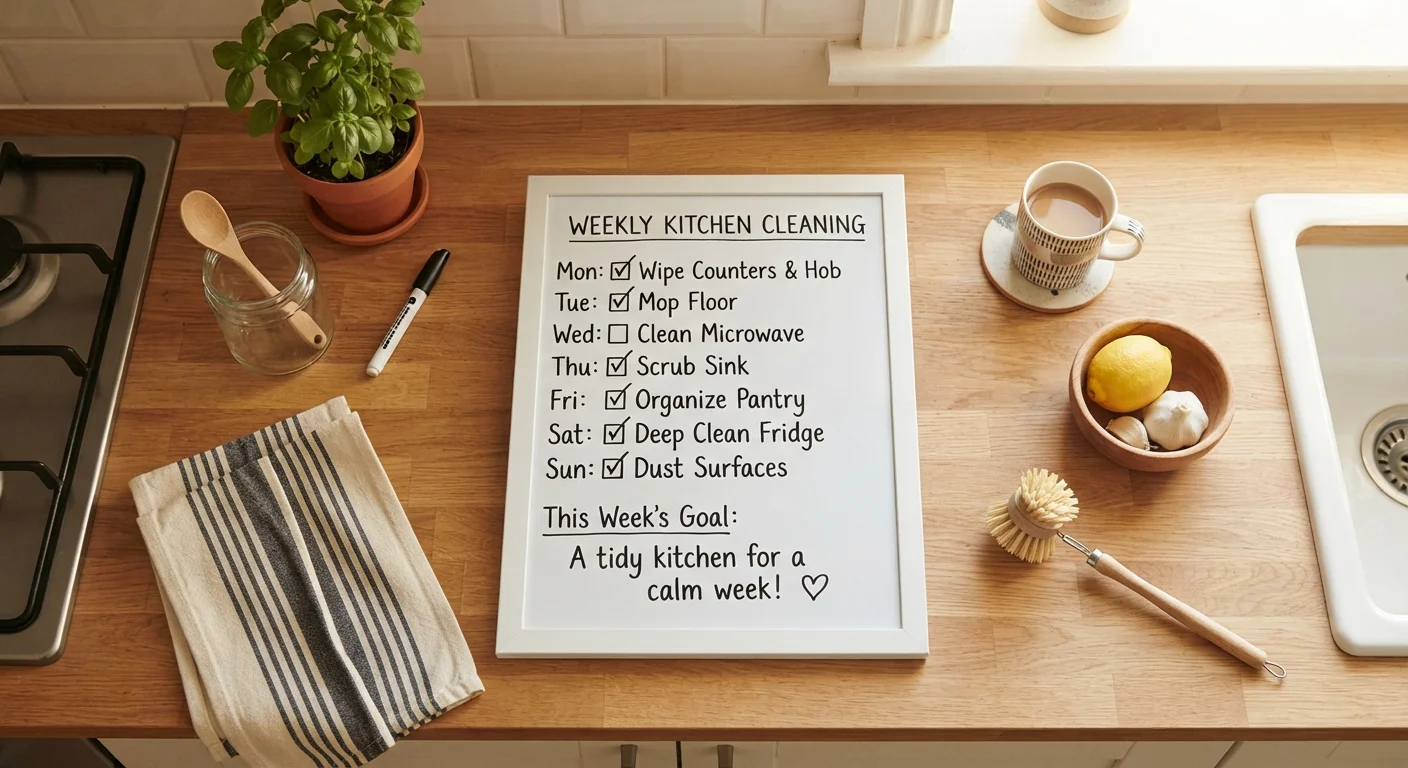
Vague schedules fail. "Vacuum sometime this week" rarely happens. Instead, assign each weekly task to a named day: Monday — bathrooms, Wednesday — floors, Friday — laundry.
Spread tasks so no single day is overwhelming. Aim for 10–20 minutes of effort per weekday and a slightly longer slot on one weekend day if needed. Keep daily tasks under five minutes each.
Attach tasks to existing daily habits
The most reliable cleaning schedule doesn't depend on willpower — it runs on habit stacking. Pair each daily task with something you already do without thinking:
- Wipe the stovetop right after cooking dinner
- Rinse and stack dishes while waiting for coffee to brew
- Do a two-minute countertop wipe before bed
Monthly tasks are harder to habit-stack, so schedule them like appointments — a specific date in your calendar, not a floating intention.
Review and adjust after two weeks
No schedule survives first contact with real life unchanged. After two weeks, look at which tasks you skipped consistently. That's data, not failure. Either move them to a more realistic day, shorten them, or accept they belong in a less frequent category.
A schedule you follow 70% of the time keeps your home meaningfully cleaner than a perfect plan you abandon entirely. Treat the first version as a working draft.
Habit Stacking Makes Cleaning Automatic
Attach cleaning tasks to things you already do reliably — wiping the stovetop after cooking, cleaning the sink while the coffee brews, or vacuuming high-traffic areas before a weekend activity. When a task is paired with an existing habit, it requires less willpower to start.
Don't Skip the Audit Step
Building a schedule without first assessing your actual home and household size almost guarantees failure. A single person in a studio apartment has very different cleaning needs than a family of four with pets. Take the audit seriously before committing anything to paper.
Once your routine is running, you'll also want a clear sense of when regular maintenance ends and a deeper clean is warranted. Deep cleaning vs. regular maintenance covers exactly that — including how often each type of effort is realistically needed.
Keeping It Going Without Burning Out
Consistency matters more than perfection. A cleaning schedule is a tool, not a contract. Life gets busy, routines shift, and some weeks the bathroom doesn't get scrubbed on Wednesday. That's fine.
Overloading Your Schedule Backfires
Listing too many tasks for a single day creates a cycle of guilt and avoidance. If you miss a day, the backlog feels overwhelming and the whole system collapses. Start with less than you think you need — you can always add tasks later.
The same principle applies to any repeatable home habit. Kitchen organisation habits that hold up over time shows how small, repeatable actions — not occasional overhauls — are what actually keep shared spaces functional. And for the tasks that don't make it onto anyone's regular schedule, home upkeep tasks that get forgotten until something fails is worth a look before those items become expensive problems.