

Key Takeaways
- Tackling one room at a time prevents overwhelm and produces visible, motivating results.
- Start with the room that causes you the most daily friction — not necessarily the messiest.
- Decluttering is distinct from cleaning; removing excess items is what changes how a space feels.
- A handful of simple habits after each session prevents clutter from quietly rebuilding.
- You don't need storage products or a renovation to make meaningful progress.
Start here
Why Room-by-Room Works Better Than Whole-Home Overhauls
Next
Starting With the Right Room
Then
The Kitchen: Function Over Minimalism
Continue
Bedrooms and Living Spaces: Reducing Visual Noise
Finish strong
Maintaining Progress Without Backsliding
Why Room-by-Room Works Better Than Whole-Home Overhauls
The appeal of a single-weekend whole-home purge is real — but for most households it leads to half-finished piles, decision fatigue, and items ending up back where they started. A room-by-room approach solves this by limiting the scope of each session to something completable in an afternoon or a few evenings.
Visible, contained progress also reinforces the habit. When one room is genuinely clearer, it becomes a reference point — a reminder of what the rest of the home could feel like. As this piece on why homes feel cluttered even after cleaning explains, cleaning and decluttering solve entirely different problems. Recognising that distinction is the first shift worth making.
Cleaning and Decluttering Are Different Tasks
A room can be scrubbed clean and still feel overwhelming if surfaces are overloaded with objects. Decluttering — reducing the number of items present — is what changes the feel of a space. Treating them as separate tasks, tackled in separate sessions, prevents each from undermining the other.
Starting With the Right Room
Choose your starting room based on friction, not mess. The room that slows you down the most every day — where you lose things, where getting ready takes longer than it should — is the one that will deliver the biggest quality-of-life return.
For many households that's the entryway or the kitchen counter. For others it's a bedroom that's become a secondary storage space. The point is to be strategic rather than gravitating toward the easiest room just to claim a quick win that doesn't change daily life much.
Decluttering
The process of removing excess items from a space so that what remains is used, valued, or needed. It's distinct from cleaning, which addresses dirt rather than volume.
Visual noise
The sense of mental busyness or unease caused by too many objects in a room's field of view, even when those objects are tidy.
One-in, one-out rule
A simple habit where bringing one new item into a room means removing one existing item, keeping the total volume of belongings stable over time.
Decision fatigue
A state of mental tiredness that comes from making too many choices in a row, which often leads to poor or deferred decisions during long decluttering sessions.
Friction point
A spot in the home where daily tasks take longer or feel harder than they should, usually due to disorganisation or excess items getting in the way.
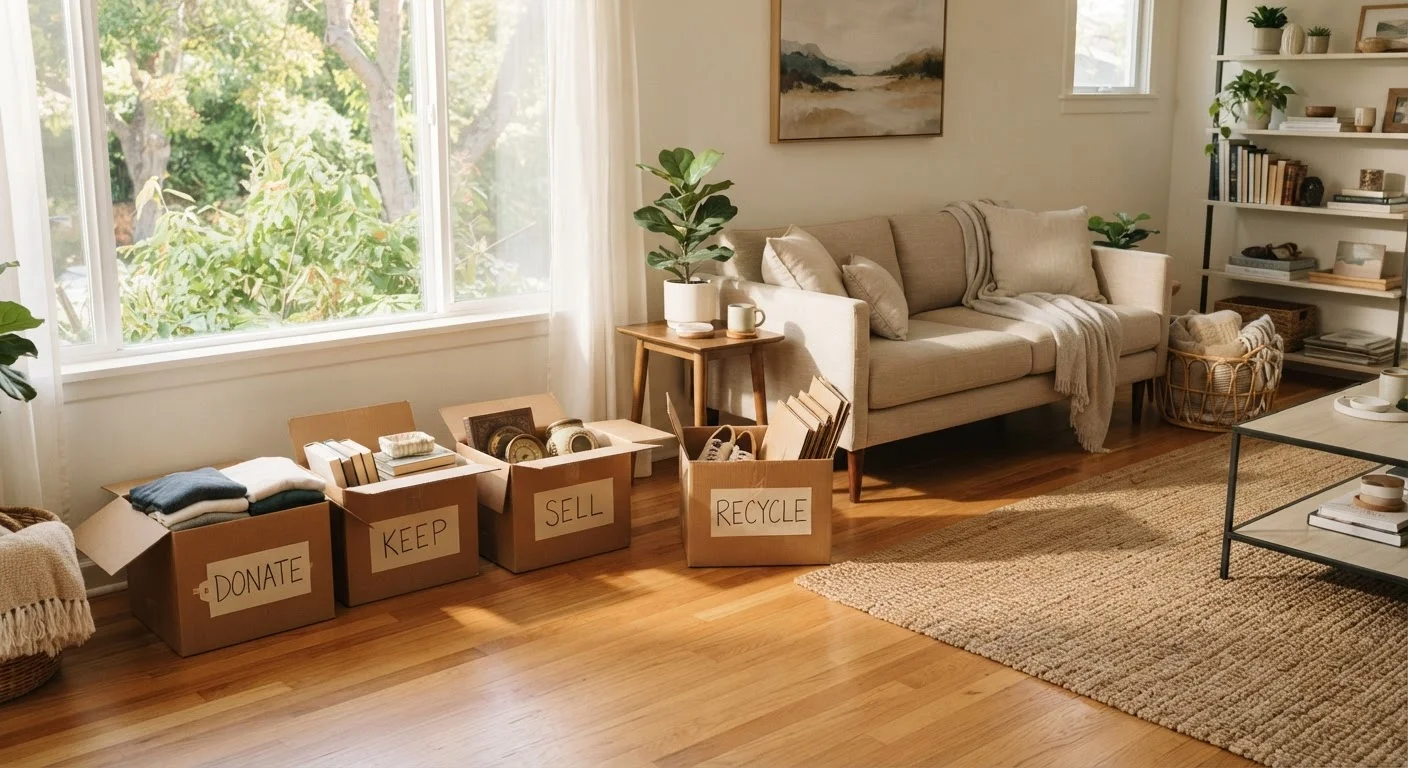
Before you begin, gather three containers: one for items to donate or give away, one for items to relocate to another room, and one for things to discard. Keeping decisions in these three lanes prevents the paralysis of open-ended sorting.
The Kitchen: Function Over Minimalism
Kitchen clutter tends to be stubborn because most items feel potentially useful. The useful test isn't whether something could be used, but whether it's been used in the past year. Gadgets, duplicate utensils, and expired pantry items are the most common culprits.
Clear counter surfaces first — they have an outsized effect on how functional and calm the kitchen feels day-to-day. Then work through cabinets one at a time, not all at once. Grouping like items together (all baking supplies, all storage containers) makes it immediately obvious when there's redundancy.
Declutter Before You Organise
Resist the urge to reorganise your kitchen cabinets before you've removed what doesn't belong. Sorting clutter into neat groupings just makes it harder to see how much excess there actually is. Remove first, then arrange what's left.
For more on keeping the kitchen working efficiently once it's decluttered, see how to keep a kitchen organised for faster cooking.
Bedrooms and Living Spaces: Reducing Visual Noise
Bedrooms accumulate clutter differently — it tends to be clothing, reading material, and items that were placed temporarily and never moved. Start with surfaces: nightstands, dressers, and chairs used as clothing storage. Each cleared surface immediately reduces visual noise, which affects how restful a room feels.
In living rooms, focus on what's stored in plain sight versus what's genuinely on display. Remote controls, chargers, and miscellaneous objects that have no designated home are the primary offenders. Giving each category of item one defined home — even just a drawer — removes the low-level mental load of seeing them scattered around.
If the room still feels congested after decluttering, that's usually a layout or light issue rather than a volume issue. Small adjustments in light and rugs can shift how spacious a room feels without removing anything further.
Maintaining Progress Without Backsliding
Clutter doesn't usually return in one dramatic event — it drifts back through small, daily additions that go unnoticed. Two habits prevent most of it: a one-in, one-out rule for new items, and a brief weekly reset of 10 minutes per room to return displaced items to their homes.
Avoid buying storage solutions until after you've decluttered. Purchasing bins and baskets first tends to create tidier-looking clutter rather than less of it. Once you know exactly what you're keeping, you can assess whether any storage additions are genuinely needed.
For rooms that feel functionally fine but still slightly overwhelming, a non-permanent storage approach can add capacity without any structural changes. And pairing decluttering with a realistic cleaning rhythm — rather than an aspirational one — tends to sustain both. A cleaning schedule designed around your actual routine makes it easier to keep the gains you've made.