

| Alternate sugar names on labels | 60+ (FDA ingredient labeling guidance) |
| Added Sugars Daily Value reference | 50 g per day (FDA Nutrition Facts label standard, 2,000-calorie diet) |
| % DV considered "high" for any nutrient | 20% or above (FDA Daily Value interpretation guidance) |
| "Added Sugars" line required since | 2020 (large manufacturers) (FDA updated Nutrition Facts rule) |
Why Manufacturers Use So Many Sugar Names
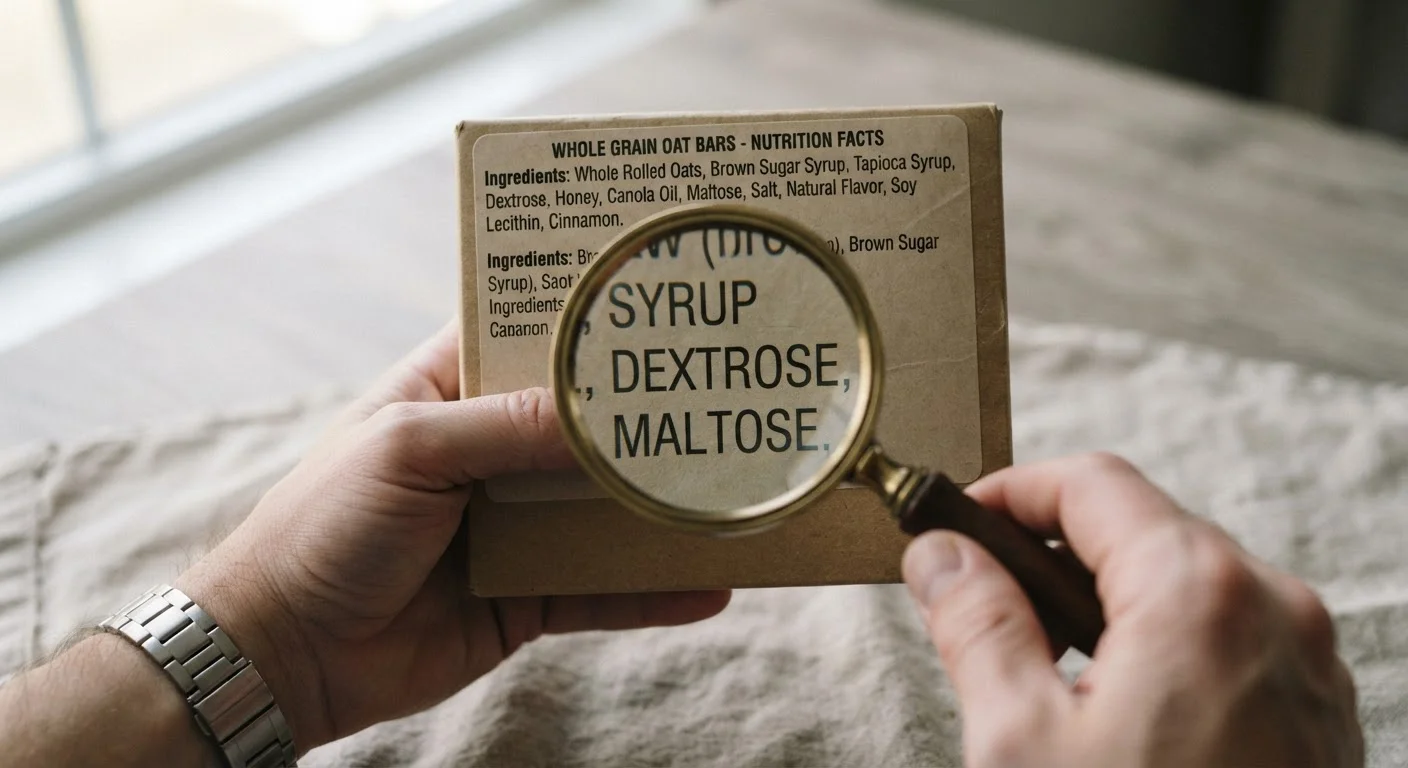
Food manufacturers are required to list ingredients in descending order by weight. One consequence: splitting sugar across several different forms — say, corn syrup, dextrose, and cane juice — pushes each one further down the list, making the product appear less sweet-heavy than it actually is. This isn't a secret practice, but it isn't widely understood either.
The result is that a single product can contain five or six distinct sweeteners, none of which appears near the top on its own — yet together they dominate the formulation. Learning to spot the full family of sweetener names is the most practical skill a label reader can develop. See our step-by-step nutrition label walkthrough for the broader context on how ingredient lists work.
| Alternate sugar names on labels | 60+ (FDA ingredient labeling guidance) |
| Added Sugars Daily Value reference | 50 g per day (FDA Nutrition Facts label standard, 2,000-calorie diet) |
| % DV considered "high" for any nutrient | 20% or above (FDA Daily Value interpretation guidance) |
| "Added Sugars" line required since | 2020 (large manufacturers) (FDA updated Nutrition Facts rule) |
The Most Common Hidden Sugar Names
Added sugars fall into a few recognisable chemical and culinary families. Once you know the patterns, scanning a label becomes much faster.
Syrups
- High-fructose corn syrup (HFCS)
- Corn syrup / corn syrup solids
- Rice syrup / brown rice syrup
- Malt syrup
- Maple syrup
- Agave nectar / agave syrup
- Golden syrup
Words Ending in -ose
- Sucrose (table sugar)
- Fructose (fruit sugar, but refined)
- Glucose
- Dextrose
- Maltose
- Lactose (naturally in dairy, but sometimes added)
- Galactose
"Natural" Sounding Alternatives
- Cane juice / evaporated cane juice
- Cane sugar / raw cane sugar
- Coconut sugar / coconut palm sugar
- Date sugar / date syrup
- Honey
- Molasses / blackstrap molasses
- Fruit juice concentrate
- Turbinado sugar
Other Common Forms
- Dextrin / maltodextrin
- Barley malt / barley malt extract
- Carob syrup
- Caramel
- Invert sugar / invert syrup
"Natural" labels on honey, coconut sugar, or fruit juice concentrate don't change the metabolic effect — your body processes added sugar from any of these sources in much the same way. For a broader look at how sugar and fibre differ in the body, see our guide to fibre vs. sugar.
Added sugars
Sugars and syrups added to foods during processing or preparation, as distinct from sugars naturally present in whole fruit, vegetables, or plain dairy. The FDA requires these to be listed separately on the Nutrition Facts panel.
High-fructose corn syrup (HFCS)
A liquid sweetener derived from corn starch in which some glucose has been converted to fructose. It is widely used in processed foods and beverages because of its low cost and extended shelf life.
Dextrose
Another name for glucose — the simple sugar your body uses for energy. When listed as an ingredient, it is an added sweetener derived from starch, commonly corn or wheat.
Invert sugar
A mixture of glucose and fructose produced by breaking down sucrose. It retains moisture and resists crystallisation, making it popular in baked goods, candies, and beverages.
Fruit juice concentrate
Juice from which most of the water has been removed, leaving a very sweet, dense liquid. When added back into processed foods it functions as a sweetener, not as a whole-fruit nutrient source.
Maltodextrin
A mildly sweet carbohydrate derived from starch (often corn, rice, or potato) used as a thickener, filler, or mild sweetener. It has a relatively high glycaemic index despite its low perceived sweetness.
Putting the Total in Context
Spotting the names is step one. Step two is checking the Nutrition Facts panel for the Added Sugars line — a federally required figure that tallies all added sweeteners regardless of what they're called in the ingredient list. The Daily Value (DV) reference is set at 50 grams of added sugar per day for a 2,000-calorie diet, though guidance from major health organisations generally recommends keeping intake well below that figure.
17 tsp
Average daily added sugar intake for US adults
According to national dietary survey data compiled by the CDC, US adults consume roughly 17 teaspoons of added sugar daily on average.
~70%
Of US packaged foods containing added sugar
Research published in peer-reviewed nutrition journals estimates that roughly 70% of packaged foods sold in US supermarkets contain some form of added sugar.
A few practical habits help put numbers in perspective:
- Check serving size first. Sugar grams listed on the label apply only to the stated serving — a package that looks like one portion often contains two or three.
- Look for multiple sweeteners in the first five ingredients. If you count more than two, the product likely leans heavily sweet even if no single sugar tops the list.
- Compare similar products. Manufacturers in the same category vary widely; comparing two yogurts or two cereals side by side quickly reveals the lower-sugar option.
- Note the % DV. A 5% DV or below is generally considered low; 20% DV or above is considered high.
For guidance on reading the full nutrition panel — including total carbohydrates, sodium, and daily value percentages — visit our article on what food labels are actually telling you. And if you're also watching sodium, our companion piece on sodium on food labels follows the same practical approach.
"Natural" Sweeteners Still Count as Added Sugar
Honey, maple syrup, agave nectar, and coconut sugar are often marketed as healthier alternatives to refined white sugar. From a labeling standpoint, the FDA counts all of them as added sugars. While these options may contain trace minerals or vary slightly in sweetness intensity, the differences in everyday quantities are nutritionally minor. Checking the Added Sugars gram count on the Nutrition Facts panel gives you a consistent, comparable figure regardless of which sweetener was used.
This article is for general informational and educational purposes only and is not a substitute for professional dietary or medical advice. Consult a registered dietitian or qualified healthcare professional for guidance tailored to your individual health needs.