

Key Takeaways
- Serving size controls every number on the label — always check it first.
- Daily Value percentages use a 2,000-calorie reference diet, which may not match your needs.
- Added sugars and total sugars are listed separately so you can spot sweetened products.
- Front-of-pack claims like 'natural' or 'low fat' are regulated differently from the Nutrition Facts panel.
- The ingredient list is ordered by weight — the first few ingredients dominate the product.
- A label can look favorable while still belonging to a heavily processed product.
Food Label
A food label is the printed panel on packaged food that discloses nutritional content, ingredient lists, serving sizes, and regulated marketing claims. In the US, the Nutrition Facts panel is standardized by the FDA and must appear on most packaged foods. It is designed to help consumers compare products and understand what they are eating.
The FDA updated the Nutrition Facts label format in 2016, requiring manufacturers to list added sugars separately from total sugars and to update serving sizes to reflect amounts people actually eat.
The Panel That Actually Holds the Information
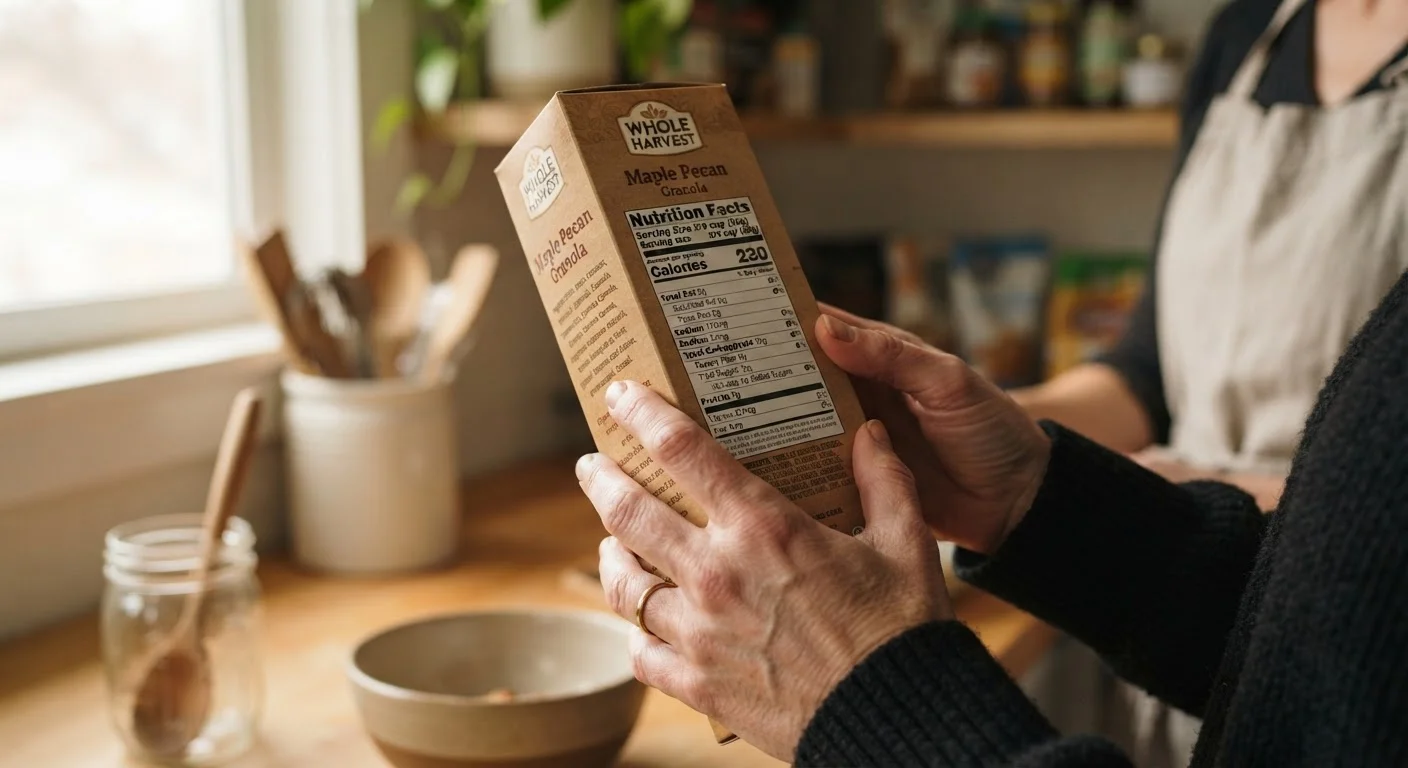
The bold black-and-white box on the back or side of most packaged food is the Nutrition Facts panel — the most regulated, standardized section of any food label. Everything else on the package is marketing; this is the data. Learning to read it quickly makes every supermarket trip more deliberate.
Start at the top: serving size. This single line sets the scale for every number below it. If a bag of chips lists 140 calories per serving but contains three servings, eating the whole bag means consuming 420 calories. Serving sizes are now required to reflect amounts people realistically eat, so they have shifted upward on many products since the 2016 FDA update.
Directly below serving size sits the calorie count. Calories measure the energy a food provides, but they say nothing about nutritional quality on their own. For a fuller picture of what calories do and don't tell you, see our explainer on calorie counting.
Check Serving Size Before Anything Else
Before reading any other number on the Nutrition Facts panel, find the serving size and the servings per container. Every calorie, gram, and percentage listed applies to that one serving. For snack foods especially, the listed serving is often smaller than what most people eat in one sitting.
For a row-by-row walkthrough of every line on the panel — from total fat to vitamin D — Reading a Nutrition Facts Panel Without Getting Lost covers each element in detail.
Daily Values: A Reference Point, Not a Personal Target
The right-hand column of the Nutrition Facts panel lists % Daily Value (%DV) for most nutrients. These percentages are benchmarked against a 2,000-calorie-per-day reference diet — a standardized figure used for comparison, not a target tailored to any individual.
As a rough guide, the FDA suggests treating 5% DV or less as low for a nutrient and 20% DV or more as high. That rule of thumb is useful in two directions:
- Nutrients you generally want less of — saturated fat, sodium, and added sugars — benefit from choosing products with lower %DVs.
- Nutrients you generally want more of — dietary fiber, calcium, iron, vitamin D — are worth seeking out at higher %DVs.
70%+
Of US packaged foods contain added sugars
Analysis of US food supply data published in nutrition research journals has found added sugars present in a large majority of packaged food products across most categories.
2,300mg
Daily sodium reference value for adults
The FDA's daily reference value for sodium is 2,300mg — used as the benchmark for %DV calculations on all US Nutrition Facts panels.
5% or less
%DV threshold considered 'low' for a nutrient
The FDA uses this guideline to help consumers quickly assess whether a serving provides a small or significant contribution of a given nutrient.
Sodium is one of the easiest nutrients to misjudge on a label because it accumulates across multiple meals. Sodium on Food Labels explains how to spot high-sodium products and what the daily reference value actually represents.
What the Ingredient List Reveals
The ingredient list is legally required to run in descending order by weight. Whatever appears first makes up the largest proportion of the product. If added sugar — listed under names like corn syrup, dextrose, or cane juice — appears in the first three ingredients, sugar is a primary component of that food.
The ingredient list also surfaces processing level. A long list of unfamiliar additives, emulsifiers, or artificial flavors is a reliable indicator of an ultra-processed product, even if the nutrition panel looks reasonable. Understanding that distinction matters — Whole Foods vs. Ultra-Processed Foods explains the spectrum and why it affects nutritional quality.
Added Sugars Now Have Their Own Line
Since the FDA's 2016 label update, added sugars must be listed as a sub-item under total sugars, along with their own %DV. This makes it easier to distinguish between sugars naturally present in a food (like lactose in yogurt) and sugars introduced during manufacturing. Look for this line when evaluating sweetened products.
Fats listed on the panel deserve a closer look too. Saturated, unsaturated, and trans fats behave very differently in the body. Fats Demystified breaks down each type clearly.
Front-of-Pack Claims: Regulated but Limited
Terms like low fat, high protein, good source of fiber, and reduced sodium on the front of a package are regulated by the FDA — each has a specific numerical definition. However, terms like natural, wholesome, or clean carry no standardized legal meaning and are essentially marketing language.
Knowing which claims are defined — and what those definitions actually require — prevents well-intentioned shoppers from being misled. Nutrition Claims on Packaging maps out what each phrase is and is not permitted to mean under current rules.
Reading the full label — panel, ingredient list, and front claims together — gives a far more complete picture than any single element alone.
This article is for general informational purposes only and does not constitute medical or dietary advice. For guidance tailored to your individual health needs, consult a qualified healthcare or nutrition professional.