

Key Takeaways
- Clicking 'Agree' creates a legally binding contract, even without reading the document.
- Most ToS agreements grant companies broad rights to use and share your personal data.
- Arbitration clauses in many agreements limit your ability to sue the company in court.
- Companies can change their terms at any time, often with minimal notice to users.
- Knowing which sections to skim can help you spot the clauses that matter most.
Terms of Service (ToS)
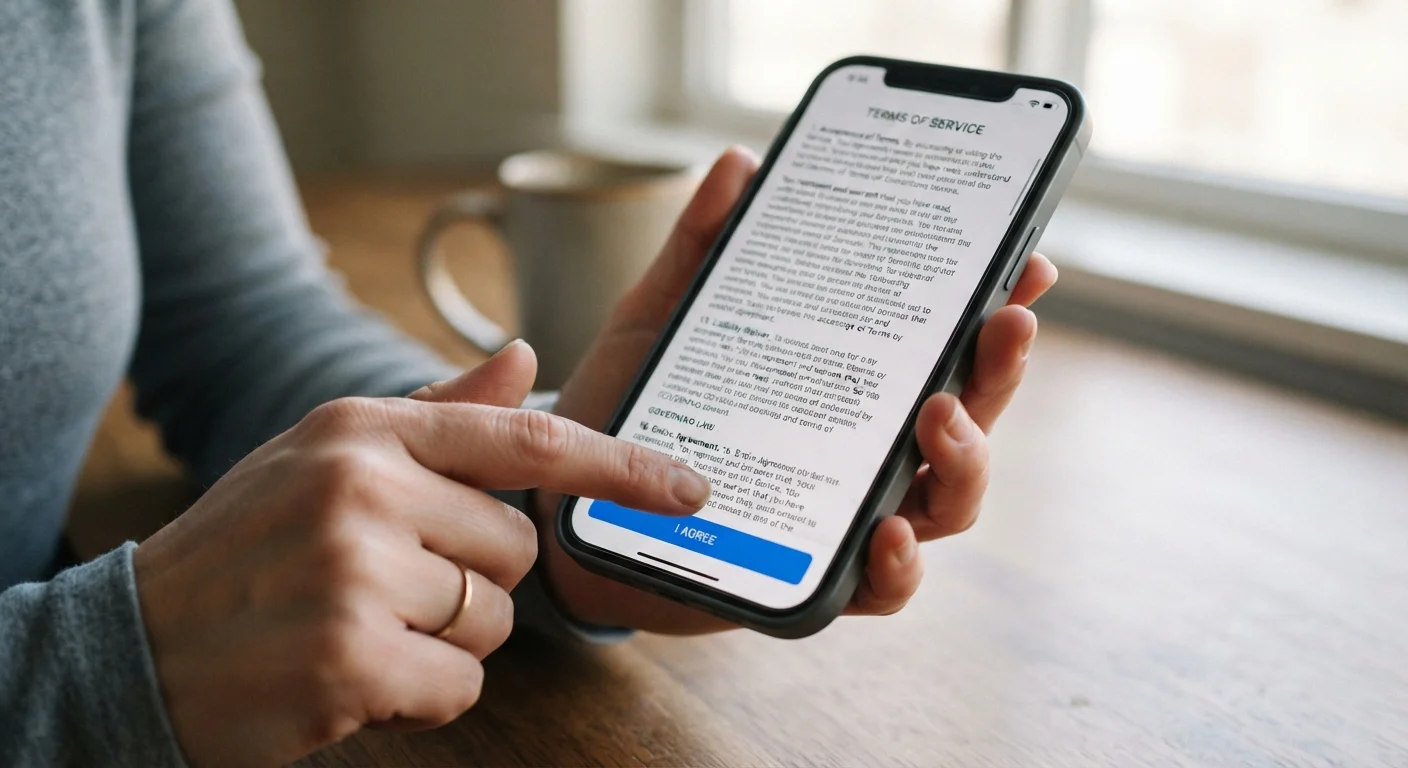
A Terms of Service agreement is a legal contract between you and an app or website that outlines the rules for using the service. It explains what the company can do with your data, what rights you give up, and what happens if something goes wrong. By tapping 'Agree,' you're legally accepting those terms — even if you never read them.
ToS documents are also called End User License Agreements (EULAs) or Terms and Conditions (T&C). They are legally binding in most jurisdictions, though some courts have found certain clauses unenforceable.
Why Nobody Reads Terms of Service — and Why That's a Problem
Research has consistently found that the overwhelming majority of users never read app agreements before accepting them. That's understandable — these documents are long, dense, and written in legal language designed for lawyers, not everyday users. One widely cited academic study estimated that fully reading every privacy policy a typical internet user encounters in a year would take hundreds of hours.
But clicking past these agreements isn't consequence-free. You are entering a real contract, and the terms you skip can affect your privacy, your legal rights, and even your ownership of content you create. The good news: you don't need to read every word. You just need to know which sections to look for.
~3,000
Average word count of a major app's ToS
Analyses of popular platform agreements show most run between 2,000 and 5,000 words — comparable in length to a short academic paper.
91%
Users who skip reading digital agreements
A Deloitte consumer survey found that approximately 91% of people consent to terms and conditions without reading them.
12th grade+
Typical reading level required for ToS documents
Researchers have found that most terms-of-service documents require a college-level reading ability, well above the average adult reading level in the U.S.
The Five Clauses That Deserve Your Attention
Most ToS documents follow a predictable structure. Here are the sections that have the most practical impact on everyday users:
1. Data Collection and Use
This section — often a separate Privacy Policy linked within the ToS — explains what personal information the app collects, how it's stored, and who it's shared with. Look for phrases like "third-party partners" or "affiliated services," which signal that your data may move beyond the app itself. For a deeper look at what apps typically gather, see what apps actually know about you.
2. License to Your Content
If the app lets you upload photos, write posts, or record audio, the ToS almost certainly includes a content license. This grants the company the right to use, display, and sometimes sublicense what you create — often without paying you. The scope varies, but broad licenses are common on social and creative platforms.
3. Arbitration and Class Action Waivers
Many U.S. app agreements include a clause requiring disputes to go to private arbitration rather than the court system, and waiving your right to join class-action lawsuits. This limits your legal options if you're harmed by the service.
4. Termination Rights
Companies typically reserve the right to suspend or delete your account at any time, for any reason. If you rely on an app for important files or communication, this clause is worth noting — always keep backups of anything that matters.
5. Auto-Renewal and Billing
Free trials that roll into paid subscriptions, mid-cycle price changes, and automatic renewals are all standard. The ToS spells out exactly how billing works. To understand how these charges can accumulate, see how app subscription billing is structured.
A Faster Way to Scan Any Agreement
Services like ToS;DR (Terms of Service; Didn't Read) crowdsource plain-language summaries of major platform agreements and rate them on fairness. Checking a service's rating before signing up takes less than a minute and can surface serious red flags. It won't replace reading for high-stakes decisions, but it's a practical starting point for everyday apps.
A Practical Approach to Agreements You'll Actually Use
You don't need to become a legal expert to use apps more wisely. A few habits go a long way:
- Use Ctrl+F (or the search function): Search for words like "arbitration," "license," "share," and "third party" to jump straight to the relevant clauses.
- Check the permissions the app requests: The ToS describes rights in abstract terms; actual permissions are more concrete. Learn more with our guide to why apps ask for so many permissions.
- Review your privacy settings regularly: Agreements change, and so do default settings. A privacy settings audit on your phone is the fastest way to see what you've actually authorized.
- Google the app name + "ToS concerns": Privacy researchers and journalists often flag problematic clauses, saving you the work of finding them yourself.
Terms Change — Often With Little Fanfare
Most agreements give companies the right to update their terms at any time, with notice delivered by email or an in-app banner. In practice, many users never see these updates. If an app plays a significant role in your work or personal life, it's worth checking its ToS page once or twice a year for meaningful changes — particularly to data-sharing or billing sections.
No app agreement is perfectly fair to users — that's the reality of free or low-cost digital services. But knowing the common patterns means you're making an informed choice, not an accidental one.